
Description
Product Overview
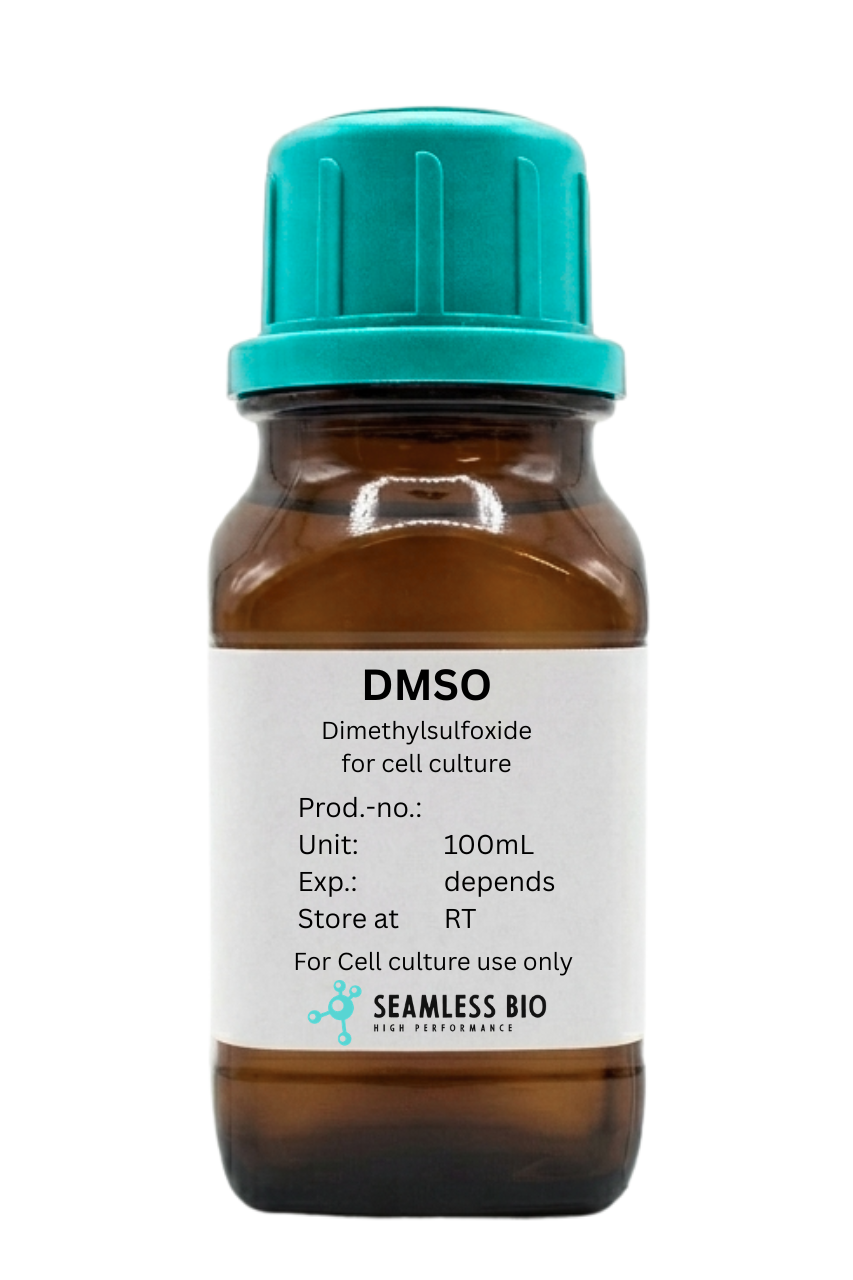
SeamlessBio DMSO ≥99.9% (Dimethyl Sulfoxide, CAS 67-68-5) is pharmaceutical-grade, sterile-filtered (0.2 µm) DMSO supplied for use as a cryoprotectant in cell therapy and cell culture freezing media, as a solubilising agent for poorly water-soluble compounds, and as a differentiation reagent in cell biology. USP-compliant, endotoxin-tested (≤1 EU/mL), supplied in DMSO-resistant glass vials with full batch documentation. SeamlessBio supplies DMSO as part of a complete cryopreservation package — DMSO and HSA 20% from a single source with matched CoA, CoO, and SDS documentation.
Technical Specifications
| Parameter | Specification |
|---|---|
| Chemical name | Dimethyl Sulfoxide (DMSO) |
| CAS number | 67-68-5 |
| Purity | ≥99.9% (GC) |
| Form | Sterile solution |
| Sterile filtration | 0.2 µm |
| Endotoxin | ≤1 EU/mL (LAL method) |
| Mycoplasma | Tested — negative |
| Water content | ≤0.1% (Karl Fischer) |
| Quality standard | USP-compliant, Cell Culture Grade |
| Melting point | +18.5 °C (liquid at room temperature) |
| Storage | +15 to +25 °C, protected from light — do not freeze |
| Packaging | DMSO-resistant glass vial |
| Documentation | CoA, SDS, sterility test, mycoplasma test — batch-specific |
Applications
| Application | Description |
|---|---|
| Cryopreservation — cell therapy | Standard intracellular cryoprotectant for CAR-T cells, NK cells, MSCs, HSCs, and iPSCs. Typical freezing medium: 10% DMSO final + 2–5% HSA 20% in serum-free base medium or PBS. SeamlessBio supplies both components from a single source with matched documentation. |
| Cryopreservation — cell lines | Freezing of established mammalian cell lines (CHO, HEK293, Vero, Jurkat, HeLa). Standard protocol: 10% DMSO in complete medium, or 90% FBS / 10% DMSO for long-term storage. |
| Solubilisation of poorly soluble compounds | Polar aprotic solvent for drug and probe stock solutions in pharmacology, toxicology, and compound screening. Typical working concentration: 0.1–1% v/v in cell culture medium. |
| Cell differentiation | At ≥1% concentration, DMSO acts as a differentiation inducer for specific cell lines — particularly in neural and erythroid differentiation protocols in basic research. |
Cryopreservation Bundle
For a complete, documented cryopreservation process in cell therapy manufacturing, SeamlessBio recommends the combination of DMSO and HSA 20% from a single source:
| Component | Function | Product |
|---|---|---|
| DMSO 10% final | Intracellular cryoprotectant — prevents ice crystal formation and membrane damage during controlled-rate freezing | DMSO ≥99.9% (this product) |
| HSA 20% (1–5% final) | Extracellular protein — membrane stabilisation, osmotic protection, prevention of cell clumping during freeze-thaw | HSA 20% Solution |
| Base medium / carrier | Volume carrier — PBS, PlasmaLyte A, or serum-free medium depending on process | On request |
Handling Notes
| Property | Note |
|---|---|
| Solidification | DMSO solidifies at +18.5 °C — re-liquefy by warming to room temperature; quality is unaffected by controlled re-melting |
| Hygroscopic | Absorbs moisture from air — reseal immediately after use; water uptake raises endotoxin risk and reduces purity |
| Skin penetration | DMSO rapidly penetrates skin and can carry dissolved substances across the skin barrier — always wear nitrile gloves when handling |
| Compatible containers | Glass or HDPE only — DMSO degrades many plastics including polystyrene and polypropylene; never use standard plastic pipettes for undiluted DMSO |
| Clinical ATMP use | For direct infusion to patients (CAR-T, HSC transplantation), a medical device-registered DMSO (e.g. WAK-Chemie CryoSure®) is the regulatory standard; this product is suitable for GMP-adjacent manufacturing and Phase I/II excipient use |
Available Formats
| Format | Volume |
|---|---|
| Glass vial | 100 mL |
| Bulk | On request |
Key Benefits
Batch Reservation
Reserve validated lots up to 36 months for reproducible long-term cryopreservation workflows in cell therapy manufacturing.
Full Documentation
CoA, SDS and sterility test — from ISO 9001 and ISO 13485 certified partner facilities. Additional documents on request.
EU & Swiss Supply
Sourced from certified EU partner facilities — fast delivery across EU, UK and Switzerland. DMSO and HSA 20% from a single source.
Frequently Asked Questions
What is the standard DMSO concentration in cell therapy cryopreservation media?
The standard final DMSO concentration in cryopreservation media for cell therapy products (CAR-T, NK cells, MSCs, HSCs) is 10% v/v. This is combined with 1–5% HSA from a 20% stock solution and a compatible base medium (PBS, PlasmaLyte A, or serum-free medium). The 10% DMSO concentration has been validated across decades of clinical practice for haematopoietic stem cell transplantation and is the concentration referenced in the majority of ATMP product dossiers. Higher concentrations (up to 20%) are used for some specific applications such as sperm and oocyte cryopreservation, but are cytotoxic in standard mammalian cell culture. For cryopreservation of research cell lines, 90% FBS / 10% DMSO is a widely used alternative to serum-free freezing medium.
Is this DMSO suitable for clinical ATMP manufacturing (CAR-T, HSC)?
SeamlessBio DMSO ≥99.9% is USP-compliant and suitable for GMP-adjacent manufacturing processes, including use as a cryoprotectant excipient in Phase I and Phase II ATMP clinical trial batches. For licensed ATMPs where DMSO will be directly infused to patients as part of the final drug product (e.g. in cryopreserved CAR-T or HSC infusion bags), a medical device-registered DMSO such as WAK-Chemie CryoSure® is the standard regulatory approach in Europe and is listed in the European Pharmacopoeia. Contact our team to discuss which grade is appropriate for your regulatory strategy and phase of development.
Why does DMSO solidify, and does re-melting affect quality?
DMSO has an unusually high melting point of +18.5 °C for an organic solvent, meaning it solidifies at normal room temperature if the environment is cool. This is a physical property of the compound, not a quality defect. Solidified DMSO can be re-liquified by warming the sealed vial to room temperature (20–25 °C) — quality, purity, and sterility are not affected by this process as long as the vial remains sealed during re-melting. Never heat above 40 °C and never open a partially solidified vial, as this introduces moisture and risks contamination.
Can DMSO be ordered together with HSA 20% as a cryopreservation bundle?
Yes — and this is the recommended approach for cell therapy manufacturers. SeamlessBio supplies both DMSO ≥99.9% and HSA 20% Solution with matched batch documentation (CoA, CoO, SDS) from a single point of contact. Ordering both components together simplifies documentation management for GMP-adjacent processes, reduces supplier qualification burden, and ensures documentation consistency for ATMP batch records. Contact us with your required volumes and timeline for a combined quote.
What container materials are compatible with undiluted DMSO?
DMSO is a powerful solvent that degrades many common plastics. Compatible materials for storage and handling of undiluted DMSO include borosilicate glass (preferred), high-density polyethylene (HDPE), and fluoropolymers (PTFE, FEP). Incompatible materials include polystyrene, polypropylene, standard PVC tubing, and most rubber septa — DMSO will extract plasticisers and degrade the container wall, contaminating the product. SeamlessBio supplies DMSO in DMSO-resistant glass vials. When diluting for use, use glass or HDPE pipettes and containers; at concentrations below 20% v/v in aqueous solution, standard polypropylene labware is generally acceptable for short-term use.
Request a Quote or Sample
48h response · EU & Swiss Supply · Batch reservation available · Full documentation
 English
  Deutsch