
Description
Product Overview
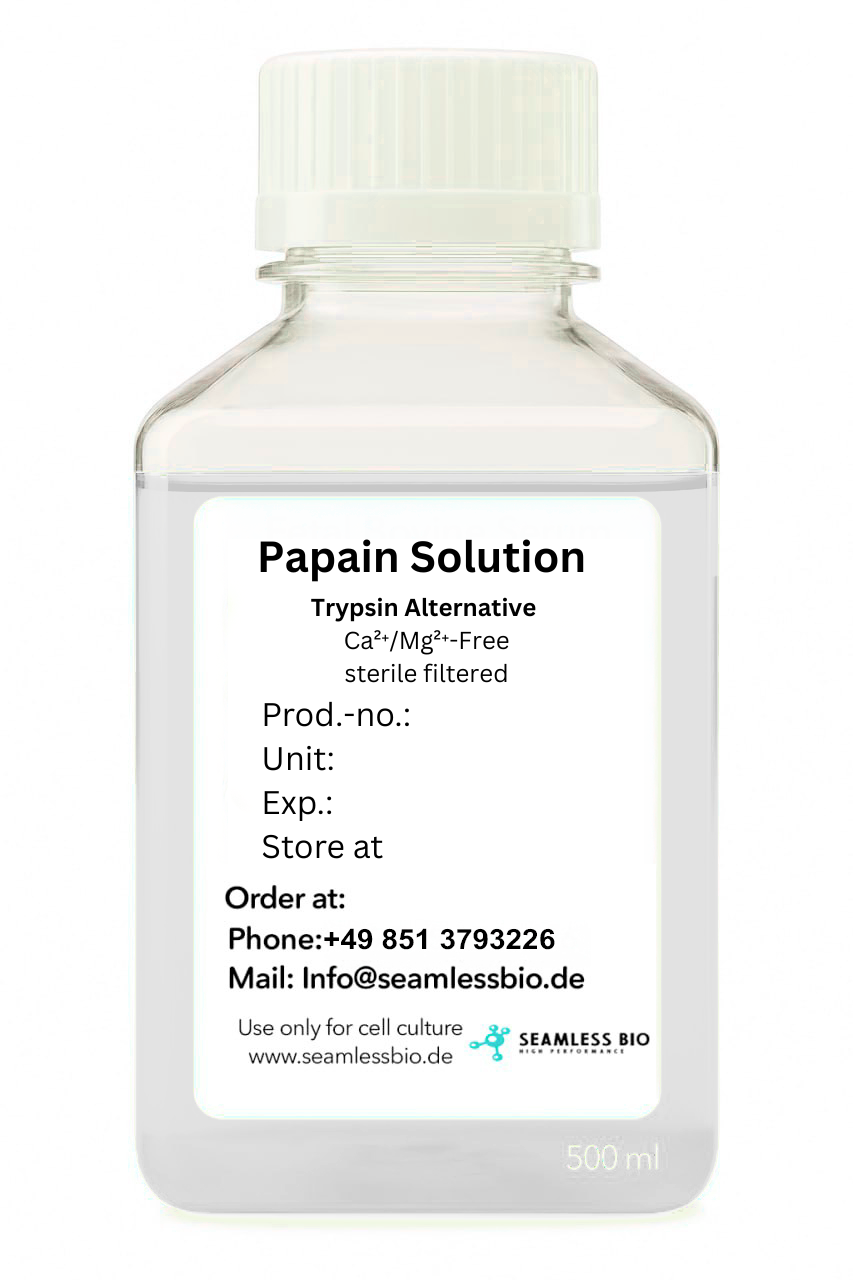
SeamlessBio Papain Solution (61.25 mg/L) is a ready-to-use, plant-derived proteolytic enzyme formulated in D-PBS without Ca²⁺ and Mg²⁺ and without phenol red. Sourced from unripe Carica papaya, papain offers a sustainable, animal-free alternative to trypsin for gentle and effective dissociation of cell–cell and cell–matrix connections. The calcium- and magnesium-free formulation enhances enzymatic efficiency in cell detachment and tissue digestion. Sterile filtered and stable for 24 months at −20 °C. Suitable for primary cells, stem cells, neuronal cells, and any application where preservation of surface receptor integrity is critical.
Technical Specifications
| Parameter | Specification |
|---|---|
| Product | Papain Solution |
| Concentration | 61.25 mg/L |
| Formulation | Dissolved in D-PBS (Dulbecco’s PBS) |
| Ca²⁺ / Mg²⁺ | Free of calcium and magnesium ions |
| Phenol Red | Phenol red-free |
| Source | Carica papaya (unripe papaya) |
| Filtration | Sterile filtered |
| Storage | −20 °C |
| Shelf life | 24 months at −20 °C |
| Format | Ready-to-use solution |
| Regulatory | Research Use Only (RUO) |
Applications
| Application | Description |
|---|---|
| Primary cell culture | Gentle isolation and passaging of primary cells from tissue with preserved receptor function and higher post-detachment viability |
| Stem cell culture | Dissociation of sensitive stem cell lines with minimal induction of cell stress — suitable for iPSC, ESC, and MSC workflows |
| Neuronal cells | Detachment of neurons and neuron-like cell lines without damage to neurites or loss of surface markers |
| Flow cytometry | Preparation of single-cell suspensions with intact surface epitopes for immunophenotyping and cell sorting |
| Receptor & signalling studies | Analysis of integrins, intracellular signalling pathways, and receptor-mediated processes where trypsin-induced surface damage would compromise results |
| Proteomic analysis | Cell detachment prior to downstream protein analyses where surface protein integrity is required |
Papain vs. Trypsin
| Feature | Papain | Trypsin |
|---|---|---|
| Source | Plant-derived (Carica papaya) | Animal-derived (bovine / porcine pancreas) |
| Action on cells | Gentle — lower risk of surface damage | More aggressive — cleaves surface proteins broadly |
| Surface receptor preservation | High — integrins and binding receptors largely intact | Reduced — aggressive cleavage can destroy key surface epitopes |
| Cell viability post-detachment | Often higher | Variable — dependent on exposure time |
| Incubation time | 5–15 min at 37 °C (cell-line dependent) | 2–10 min at 37 °C (cell-line dependent) |
| Temperature sensitivity | Robust to moderate variation | More temperature- and buffer-dependent |
| Sustainability | Animal-free, plant-based | Requires animal-derived pancreatic tissue |
Available Formats
| Article Number | Product | Size |
|---|---|---|
| SB-PAP-100 | Papain Solution 61.25 mg/L in D-PBS | 100 mL |
| SB-PAP-500 | Papain Solution 61.25 mg/L in D-PBS | 500 mL |
Key Benefits
Plant-Based & Animal-Free
Derived from Carica papaya — a sustainable, animal-free alternative to trypsin compatible with serum-free and xeno-free workflows.
Gentle Cell Detachment
Ca²⁺/Mg²⁺-free formulation preserves surface receptors and integrin integrity — higher viability and better downstream results for sensitive cell types.
Ready-to-Use & Stable
Sterile filtered, 61.25 mg/L in D-PBS — phenol red-free, 24-month shelf life at −20 °C. No preparation required.
Frequently Asked Questions
Why use papain instead of trypsin for cell detachment?
Trypsin is a broad-spectrum serine protease derived from animal pancreas that cleaves proteins at lysine and arginine residues — including surface integrins and membrane receptors — which can compromise downstream assays dependent on intact surface markers. Papain is a cysteine protease from unripe papaya with narrower cleavage specificity, resulting in gentler dissociation with better preservation of surface receptor integrity and typically higher post-detachment cell viability. It is particularly recommended for flow cytometry, receptor studies, primary cell culture, and any protocol where trypsin-induced surface damage has been a problem.
Why is the papain solution formulated without Ca²⁺ and Mg²⁺?
Divalent cations — calcium (Ca²⁺) and magnesium (Mg²⁺) — stabilize cell–cell junctions and extracellular matrix interactions, reducing enzymatic access to cleavage sites. Formulating in D-PBS without these ions removes that stabilization, improving efficiency of cell detachment at the same enzyme concentration. It also removes the need for EDTA or EGTA addition and prevents enzyme activity from being suppressed by metal-ion complexation.
What protocol is recommended for papain-based cell detachment?
Remove culture medium completely. Wash the cell layer with D-PBS (without Ca²⁺/Mg²⁺) to remove serum, which inhibits papain activity. Add papain solution to cover the cell layer (approx. 1–2 mL per 25 cm²). Incubate at 37 °C for 5–15 minutes, checking detachment under the microscope every few minutes. Stop the reaction by adding serum-containing medium (serum proteins inhibit papain). Centrifuge and resuspend the cell pellet as required. Exact incubation times should be optimised for each cell line.
Is papain suitable for serum-free or xeno-free cell culture?
Yes. Because papain is plant-derived and this formulation contains no animal-derived components, it is compatible with serum-free and xeno-free workflows. To stop papain activity without serum, a soybean trypsin inhibitor (SBTI) solution or alternative protease inhibitor can be used. Contact us if you need guidance on inhibitor selection for your specific protocol.
What is the shelf life and how should papain solution be stored?
The papain solution is stable for 24 months at −20 °C. Once thawed, use within the working session or aliquot into single-use volumes before freezing to avoid repeated freeze-thaw cycles. Do not store at +4 °C long-term, as enzymatic activity declines. The phenol red-free formulation allows direct use in fluorescence-based assays without colour interference.
Request a Quote or Sample
48h response · EU & Swiss Supply · Full documentation · Plant-based cell dissociation
 English
  Deutsch