
2D Bioprocessing Bags
Flat, pillow-style single-use bags for media preparation, buffer mixing and intermediate storage — 150 mL to 50 litres. Multilayer PE/EVOH film, gamma-sterilised, built to your drawing. Pilot lots from 100 units, about 2–3 weeks.
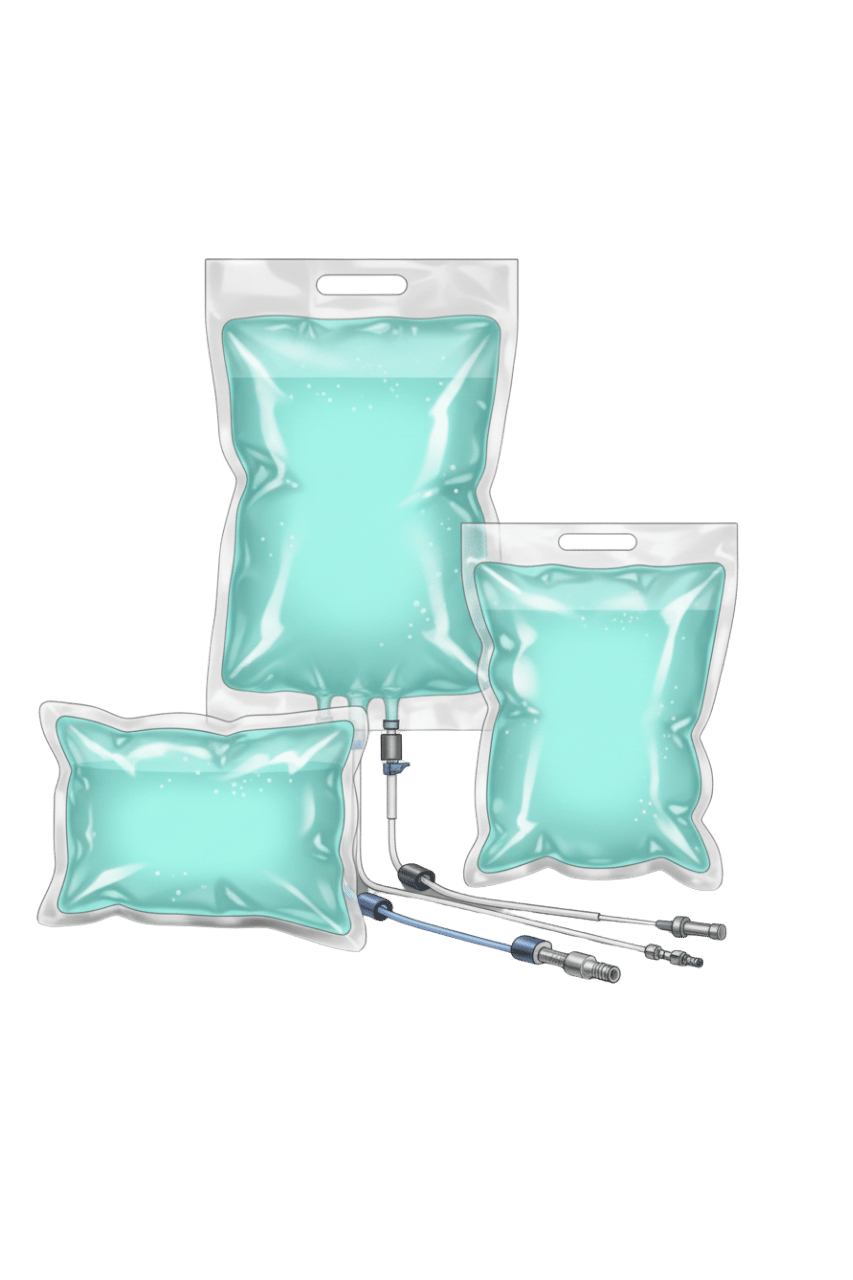
Single-use bioprocessing bags – made to your process
Request a quote – built to your drawing, gamma-sterilised (SAL 10⁻⁶), CoA with every lot. About 2–3 weeks for 100 units.
2D bioprocessing bags are flat, single-use containers for media preparation, buffer mixing, intermediate product hold and chromatography feed. SeamlessBio supplies them made to order in volumes from 150 mL to 50 litres — USP <87>/<88> Class VI multilayer PE/EVOH film, gamma-sterilised (ISO 11137, SAL 10⁻⁶), made in an ISO Class 7 cleanroom. Pilot lots from 100 units, CoA with every lot.
Optimised for Mixing
Flat geometry delivers maximum surface area on orbital shakers and rocking platforms — ideal for powder media reconstitution and buffer component dissolution.
Multilayer PE/EVOH film
ULDPE/LLDPE fluid-contact layer, EVOH gas barrier, outer protective PE layer. Controlled extractables profile, USP <87>/<88> Class VI certified, ISO 10993 compliant.
150 mL to 50 Litres
Full volume range from bench-scale process development to pilot-scale production. Pilot lots from 100 units. Same documentation regardless of quantity.
Custom Port Configurations
Luer-lock, 3/8" male insert, AseptiQuick G, PCS/TPE tubing, end plug — configurable per SKU. Every configuration is built to order.
What is a 2D bioprocessing bag?
A 2D bioprocessing bag is a flat, pillow-shaped single-use bag made from multilayer film. It is used for media preparation, buffer storage, sampling and the freezing and thawing of drug substance. Our 2D bags cover 150 mL to 50 L.
The flat shape gives an even layer of liquid, so the bag freezes and thaws evenly across its whole area. Freeze rates stay reproducible from lot to lot, which is why 2D bags are the standard format for freezing proteins, antibodies and viral vectors. Our film is suitable for freeze-thaw down to −80 °C.
Up to 50 L and for anything you freeze, use 2D bags. From 100 L, for large buffer and media volumes or as a liner in a mixing or bioreactor system, use 3D bags.
Where 2D bags fit in your process
2D bioprocessing bags — also called pillow bags or flat bags — are the standard single-use container for solution handling in biopharmaceutical manufacturing. Their flat geometry, combined with efficient port configurations, makes them particularly suitable for steps where mixing performance matters and where space is limited.
Unlike rigid vessels, 2D bags require no cleaning validation, no autoclave cycle and no cross-contamination control between batches. You open the bag, use it, and dispose of it. The regulatory documentation travels with the lot number — not with a reuse history.
SeamlessBio 2D bags are built to your drawing to fit the mixing systems in European bioprocessing facilities.
Typical applications
- Powder media reconstitution (dry powder + WFI)
- Buffer preparation — PBS, phosphate buffers, wash buffers
- Intermediate product hold and short-term storage
- Chromatography column feed — loading, wash, elution fractions
- Harvest collection from small bioreactor runs
- Formulation component mixing and pooling
- Seed train media preparation for cell culture scale-up
- Viral vector upstream process support (AAV, lentiviral)
- mRNA lipid nanoparticle (LNP) buffer and reagent hold
- Process development at bench and kilo-lab scale
Material specification and certifications
Every SeamlessBio 2D bag is manufactured from multilayer PE/EVOH film — a fully documented film with a BPOG extractables profile. The multilayer construction balances biocompatibility, mechanical integrity and gas barrier performance across the full volume range.
| Property | Specification |
|---|---|
| Film material | Multilayer PE/EVOH film — ULDPE fluid-contact layer · EVOH gas barrier · tie layers · LDPE outer layer |
| Volume range | 150 mL – 50 litres (2D / pillow format) |
| Biocompatibility | USP <87> cytotoxicity; USP <88> Class VI biological reactivity; ISO 10993 compliant |
| Chemical resistance | USP <788> particulate matter, USP <85> endotoxins, USP <661.1> plastics — compliant |
| Extractables | Controlled extractables profile; BPOG-aligned extractables data available on request |
| Sterilisation | Gamma irradiation, ISO 11137, SAL 10⁻⁶; double-bagged; ready-to-use from packaging |
| Manufacturing environment | ISO Class 7 cleanroom; dimensions and bill of materials checked per order; leak and pressure-decay tests in validation; full lot traceability |
| BSE/TSE status | BSE/TSE-free declaration included with each lot |
| Regulatory readiness | EU GMP Annex 1 compatible; EMA ATMP Regulation (EC) No 1394/2007 documentation ready |
Port configurations — 2D bags
Port configuration determines how the bag integrates with your process — pumps, sensors, filters, filling needles and downstream connections. SeamlessBio builds every 2D bag to order, in about 2–3 weeks for 100 units after drawing approval.
Luer-Lock (male / female)
Standard connection for small-volume transfer, sampling and venting. Compatible with standard luer syringe and tubing sets.
3/8" Male Insert
High-flow port for process fluid transfer and pump connections. Common in chromatography feed and buffer transfer applications.
AseptiQuick G
Aseptic quick-connector for closed-system integration — sterile connection and disconnection without opening the fluid path.
PCS Tubing
Polycarbonate-based silicone tubing connection for peristaltic pump integration. Standard in media preparation and buffer transfer.
TPE Tubing
Thermoplastic elastomer tubing — chemical compatibility advantage for aggressive buffer formulations and organic solvent mixtures.
End Plug
Sealed port for unused connections. Maintains sterility of unused ports during storage and transport of pre-filled or staged bags.
Who calls us — and why
ATMP manufacturers (CAR-T, gene therapy, MSC)
Clinical ATMP batches often need a small number of custom assemblies. We build them to your drawing, starting with pilot lots of 100 units; the typical lead time is 2–3 weeks after drawing approval.
Contract research organisations (CROs)
Three parallel client studies, three different bag volumes. A CRO covering 150 mL through 50 L from one supplier — with per-lot CoA and project-specific documentation — eliminates multi-vendor coordination and procurement overhead.
Vaccine manufacturers at pilot scale
Pilot batches for clinical trials need the same documentation as commercial production. The only difference is volume. We supply pilot lots from 100 units with the same documentation as serial supply: full lot traceability, CoA and biocompatibility data.
Process development labs
Early-phase development runs at 200 mL, 500 mL, 2 L. We build the assemblies you need as a pilot lot from 100 units – same film and documentation as in later production.
Documentation — CoA with every lot
Regulatory submissions require material documentation. The CoA comes with every lot; the validation guide, extractables data and declarations are available on request.
- Certificate of Analysis (CoA) — lot-specific
- USP <87> / USP <88> Class VI biocompatibility certification
- ISO 10993 compliance documentation
- USP <85> (endotoxins) and USP <661.1> compliance statement
- Gamma irradiation certificate (ISO 11137, SAL 10⁻⁶)
- ISO Class 7 cleanroom manufacturing declaration
- BSE/TSE-free declaration
- Material Safety Data Sheet (MSDS/SDS)
- BPOG-aligned extractables data — on request
- Validation guide (IQ/OQ/PQ results) — on request
2D vs. 3D bags — choosing the right format
The bag format determines process compatibility. 2D and 3D bags are not interchangeable — geometry, mixing behaviour, and volume range are fundamentally different. The wrong format means process incompatibilities and validation rework.
| Criterion | 2D Bag (pillow bag) | 3D Bag (cube bag) |
|---|---|---|
| Volume range | 150 mL – 50 litres | 100 litres – 1,000 litres |
| Geometry | Flat / pillow — lays on flat surface or hangs | Cubic / freestanding — sits in stainless steel cage or support frame |
| Mixing | Excellent on orbital shakers and rocking platforms | Paddle or impeller-driven mixing via integrated port |
| Primary use | Media prep, buffer mixing, intermediate product hold, chromatography feed | Large-volume buffer hold, bulk transfer, upstream/downstream integration |
| Typical users | Clinical ATMP, CROs, process development, pilot vaccine batches | Commercial biopharma, large-scale vaccine production, biologics manufacturing |
| Footprint | Flat — hangs in use, stacks in storage | Requires cage/frame infrastructure |
| Film material | Multilayer PE/EVOH film | Multilayer PE/EVOH (same film) |
2D bag applications — by process step
2D bags are used across upstream and downstream bioprocessing wherever a flat, stackable, mixable container offers an advantage over rigid vessels. Key process steps where 2D bags are specified:
Media preparation
Dry powder medium + WFI in a 2D bag on a rocking platform. No autoclave, no clean-in-place cycle. Prepared batch documented, sealed, delivered to the bioreactor suite.
Buffer preparation and hold
PBS, equilibration buffers, wash and elution buffers — prepared in 2D bags and held at 2–8 °C until the column is ready. No carryover risk between batches.
Chromatography feed
Clarified harvest or intermediate product held in 2D bags as chromatography column feed. Gravity or pump-assisted transfer with direct port connection to column inlets.
Harvest collection
Small bioreactor runs — 2 L, 5 L, 10 L — harvested directly into 2D bags via peristaltic pump. Closed-system transfer, no open vessel exposure.
Viral vector upstream support
AAV, lentiviral, adenoviral vector production — 2D bags for media, transfection reagent prep and intermediate hold. Clinical-grade documentation for IND/CTA submissions.
mRNA / LNP process support
Buffer and excipient hold for lipid nanoparticle formulation processes. Controlled extractables profile critical for LNP stability — documented with BPOG-aligned extractables data.
Frequently asked questions
What is the minimum order quantity for 2D bioprocessing bags?
Pilot lots start at 100 units, and serial supply follows after drawing approval. Made to order: about 2–3 weeks for 100 units, 5–6 weeks per 10,000 units after drawing approval.
What film is used in SeamlessBio 2D bags?
Multilayer PE/EVOH film (0.325 mm, made in the EU) — ULDPE fluid-contact layer, EVOH gas barrier, LDPE outer layer. The multilayer construction provides biocompatibility (USP <87>/<88> Class VI, ISO 10993), mechanical integrity across the volume range, and a controlled extractables profile suitable for BPOG-based extractables documentation.
Are 2D bags compatible with existing mixing systems?
Compatibility depends on the specific bioreactor or mixing system and the bag holder geometry. Send us your equipment model — we confirm compatibility or recommend the correct bag geometry and port configuration before you order.
How quickly are 2D bags delivered?
Made to order: about 2–3 weeks for 100 units, 5–6 weeks per 10,000 units after drawing approval. Delivery to the EU, UK and Switzerland. Contact us with your volume, configuration and required date – we confirm the lead time with the quote.
Can I order custom port configurations?
Yes. Custom port combinations, non-standard tubing types and volumes outside the standard range are available. All bags are made to order: about 2–3 weeks for 100 units after drawing approval — contact us with your process requirements for a quote.
What documentation is required for ATMP regulatory submissions?
For EMA ATMP submissions under Regulation (EC) No 1394/2007, starting material documentation for single-use containers typically includes: USP <88> Class VI certification, gamma irradiation certificate, extractables data, and BSE/TSE-free declaration. All of these are available from SeamlessBio as standard with each lot — no additional request required.
What is the difference between 2D and 3D bioprocessing bags?
2D bags are flat (pillow-style) — 150 mL to 50 L, optimised for mixing on rocking platforms or orbital shakers, typically used in media prep, buffer hold and chromatography feed. 3D bags are cubic — 100 L to 1,000 L, designed for large-volume storage and transfer in stainless-steel support frames. Both use the same multilayer PE/EVOH film and carry equivalent GMP documentation.
Request a quote or order directly
Tell us your bag volume, port configuration and required documentation. We respond within 24 hours — with pricing and lead time.
Contact Us View in Shop English
 Deutsch