
Description
Product Overview
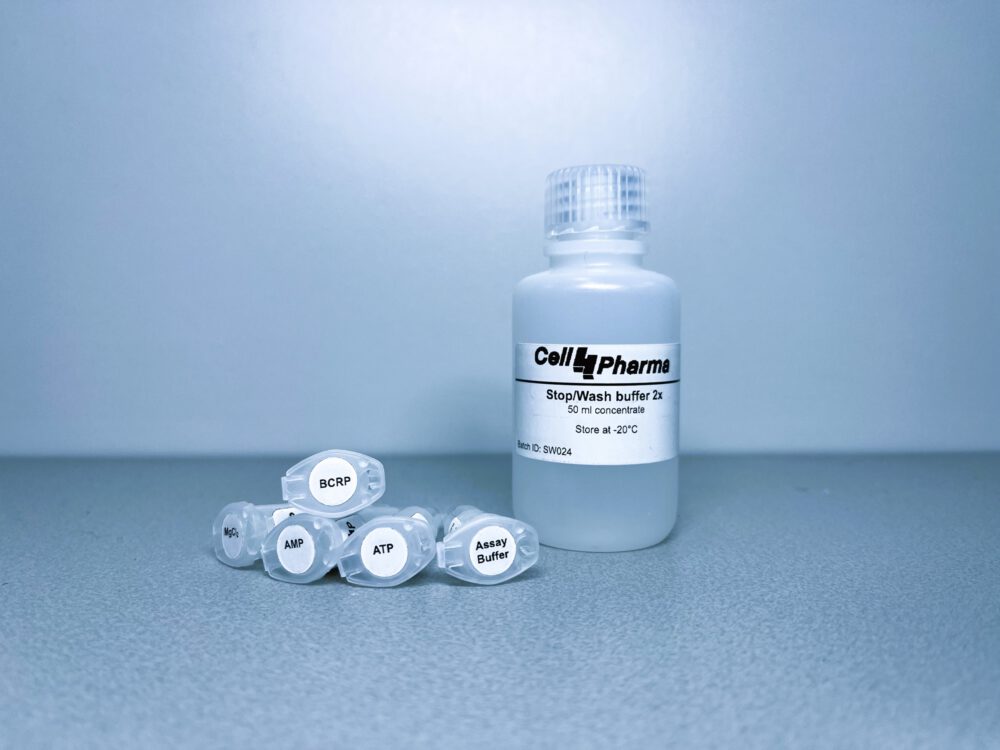
The Cell4Pharma Human BCRP Vesicle Kit (C4PVK-BCRP) provides inside-out membrane vesicles isolated from HEK293 cells transiently overexpressing the Breast Cancer Resistance Protein (BCRP / ABCG2). The kit enables ATP-dependent substrate transport studies and inhibition assays in a high-throughput format compatible with radiolabel, fluorescent, and LC-MS/MS detection. It is designed for drug-drug interaction (DDI) characterization in accordance with FDA Drug Interaction Guidance (2017) and EMA Guideline on the Investigation of Drug Interactions (2013). Kit size: 100 reactions. Manufactured by Cell4Pharma; available exclusively in the DACH region via SeamlessBio.
Transporter Profile
| Parameter | Details |
|---|---|
| Transporter name | BCRP — Breast Cancer Resistance Protein |
| Synonyms | ABCG2, MXR, CDEI-binding protein, ATP-binding cassette sub-family G member 2 |
| Gene | ABCG2 |
| Transporter family | ABC (ATP-binding cassette) — efflux transporter, half-transporter (homodimer) |
| ATP/AMP ratio | >10 (guaranteed) |
| Tissue expression | Placenta, stem cells, prostate, small intestine, brain (BBB), colon, liver, mammary gland, kidney |
| Known substrates | Estrone-3-sulfate (E1S), methotrexate, irinotecan, pantoprazole, rosuvastatin, topotecan, chlorothiazide, mitoxantrone, SN-38, glyburide |
| Known inhibitors | Ko143, fumitremorgin C (FTC), elacridar (GF120918), novobiocin |
| Regulatory relevance | FDA (2017) and EMA (2013) DDI guidance — mandatory transporter for drug development submissions |
Technical Specifications
| Parameter | Specification |
|---|---|
| Host cell | HEK293 (human embryonic kidney) — transient overexpression |
| Vesicle type | Inside-out membrane vesicles |
| Kit size | 100 reactions per kit |
| ATP/AMP ratio | >10 (lot-specific, guaranteed) |
| Detection compatibility | Radiolabel (³H/¹⁴C), fluorescent substrates, LC-MS/MS |
| Assay format | Vesicular transport assay — high-throughput compatible (96-well format) |
| Recommended control | Human Control Vesicle Kit (C4PVK009) — negative control |
| Storage | −80 °C |
| Manufacturer | Cell4Pharma |
| DACH distributor | SeamlessBio (exclusive) |
Kit Contents
| Component | Details |
|---|---|
| Vesicle vial | BCRP-overexpressing HEK293-derived inside-out membrane vesicles — 100 reactions |
| AMP-ATP solution | 100 mM — Cell4Pharma |
| Assay buffer | Cell4Pharma optimised formulation |
Applications
| Application | Description |
|---|---|
| DDI characterization (FDA/EMA) | Vesicular transport assays to determine whether a new molecular entity (NME) is a BCRP substrate or inhibitor — required data for IND, NDA, and MAA submissions per FDA (2017) and EMA (2013) transporter DDI guidance |
| IC₅₀ / inhibition studies | Concentration-response inhibition assays to determine IC₅₀ values for BCRP inhibitors using E1S or other validated probe substrates — supports in vitro-to-in vivo extrapolation (IVIVE) and R-value calculations |
| Substrate identification | ATP-dependent uptake assays to confirm active BCRP-mediated transport of candidate drugs — discriminates BCRP-specific transport from passive permeability |
| High-throughput screening | 96-well compatible format for screening compound libraries as BCRP substrates or inhibitors — compatible with radiolabel, fluorescent, and LC-MS/MS quantification |
Regulatory Compliance
The vesicular transport assay using BCRP vesicles is recommended by the FDA Drug Interaction Guidance (2017) and the EMA Guideline on the Investigation of Drug Interactions (2013) as the primary in vitro method to characterize BCRP-mediated DDI during drug development. BCRP is one of the seven transporters for which regulatory agencies require in vitro assessment as part of the standard DDI submission package, alongside P-gp, BSEP, MRP2, OAT1, OAT3, OCT2, OATP1B1, and OATP1B3. The guaranteed ATP/AMP ratio >10 demonstrates active transport function and supports data quality requirements for regulatory submissions.
Available Formats
| Format | Reactions |
|---|---|
| Kit | 100 reactions |
Key Benefits
Guaranteed Activity
ATP/AMP ratio >10 guaranteed per lot — confirms active BCRP-mediated transport and assay suitability for regulatory DDI submissions.
Full Documentation
Lot-specific CoA with ATP/AMP ratio — from Cell4Pharma ISO-certified facilities. Additional regulatory documents on request.
DACH Expert Support
Exclusive DACH distributor via SeamlessBio — scientific support for assay setup, protocol questions, and regulatory submission queries. 48h response.
Related Products
| Product | Use |
|---|---|
| Human Control Vesicle Kit (C4PVK009) | Recommended negative control for BCRP vesicular transport assays |
| Human P-gp Vesicle Kit (C4PVK010) | Parallel P-glycoprotein (ABCB1) efflux assessment — standard co-submitted DDI dataset |
| Human BSEP Vesicle Kit (C4PVK-BSEP) | BSEP/ABCB11 inhibition — bile salt export pump, required for hepatotoxicity DDI assessment |
| Human MRP2 Vesicle Kit (C4PVK-MRP2) | MRP2/ABCC2 efflux — hepatic and intestinal DDI characterization |
Frequently Asked Questions
Is BCRP assessment required by FDA and EMA for drug approval submissions?
Yes. BCRP (ABCG2) is one of the transporters for which the FDA Drug Interaction Guidance (2017) and EMA Guideline on the Investigation of Drug Interactions (2013) require in vitro assessment as part of the standard DDI submission package. Both agencies recommend the vesicular transport assay using BCRP-overexpressing inside-out membrane vesicles as the primary method to determine whether a new molecular entity is a BCRP substrate or inhibitor. Positive substrate or inhibitor findings trigger further clinical DDI study recommendations based on R-value calculations.
What does the guaranteed ATP/AMP ratio >10 mean, and why is it important?
The ATP/AMP ratio in a vesicular transport assay measures the ratio of ATP-dependent transport (in the presence of ATP) to ADP-stimulated transport (in the presence of AMP). A ratio >10 for a validated BCRP probe substrate (typically estrone-3-sulfate) confirms that the vesicles are functionally active and capable of ATP-driven efflux transport. This is a quality control benchmark that demonstrates the vesicle preparation is suitable for regulatory-grade assay work. Without a confirmed ATP/AMP ratio, transport data cannot be reliably interpreted or submitted in DDI dossiers.
Which probe substrates and inhibitors are recommended for BCRP vesicular transport assays?
The most commonly used probe substrate for BCRP vesicular transport assays is estrone-3-sulfate (E1S), which is well-characterised, commercially available in radiolabelled form (³H-E1S), and cited in both FDA and EMA guidance. Methotrexate and prazosin are also used as alternative substrates. For positive inhibitor controls, Ko143 and fumitremorgin C (FTC) are the reference BCRP inhibitors. Elacridar (GF120918) is used when dual P-gp/BCRP inhibition is relevant. The Cell4Pharma kit is compatible with all standard probe substrates and detection methods (radiolabel, fluorescent, LC-MS/MS).
Can the BCRP vesicle kit be used together with other ABC transporter kits in a multi-transporter DDI panel?
Yes — this is the standard practice in drug development. Regulatory agencies expect a complete transporter DDI package, and BCRP is typically assessed in parallel with P-gp (ABCB1) and BSEP (ABCB11), with MRP2 (ABCC2) added where hepatic efflux is clinically relevant. Cell4Pharma offers a full range of ABC transporter vesicle kits (P-gp, BSEP, MRP1, MRP2, MRP5, BCRP) that share a common assay format and buffer system, enabling parallel processing within the same experiment. The Human Control Vesicle Kit (C4PVK009) serves as the negative control across all transporter vesicle assays in the panel.
What is the recommended negative control for the BCRP vesicular transport assay?
The Human Control Vesicle Kit (C4PVK009) from Cell4Pharma is the recommended negative control. Control vesicles are prepared from HEK293 cells under the same conditions as the BCRP-overexpressing vesicles but without transporter transfection — enabling direct comparison of ATP-dependent transport in the presence and absence of BCRP. Using matched control vesicles is required to confirm BCRP-specific transport and to correct for non-specific binding and passive uptake into the vesicle preparation. Both the BCRP and Control Vesicle Kits are available via SeamlessBio for the DACH region.
Request a Quote or Technical Information
48h response · DACH exclusive via SeamlessBio · Full lot documentation · Cell4Pharma quality
 English
  Deutsch