
Description
Product Overview
The Human MRP4 Vesicle Kit (HEK293) provides ready-to-use inside-out membrane vesicles overexpressing human MRP4 (ABCC4) for ATP-dependent vesicular transport studies. MRP4 is expressed at the apical membrane of renal proximal tubule cells, hepatocyte basolateral membrane, platelets, and the blood-brain barrier. It transports a broad substrate profile including cyclic nucleotides (cAMP, cGMP), prostaglandins, urate, and nucleotide analogue antiviral and anticancer drugs — making it particularly important for renal DDI risk assessment, antiviral drug development, and platelet biology.
Guaranteed ATP/AMP transport ratio >5 per lot. Use alongside the Human Control Vesicle Kit for matched background subtraction — required for regulatory-grade DDI data per FDA DDI Guidance (2020) and EMA DDI Guideline (2013/2022).
Transporter Profile
| Property | Detail |
|---|---|
| Transporter name | MRP4 — Multidrug Resistance-Associated Protein 4 |
| Gene | ABCC4 |
| Protein family | ABC transporter, ABCC subfamily |
| Tissue expression | Renal proximal tubule (apical), hepatocyte (basolateral), platelets, blood-brain barrier, lung, prostate |
| Key substrates | cAMP, cGMP, PMEA (adefovir), tenofovir, methotrexate, leucovorin, urate, prostaglandins (PGE₁, PGE₂), thromboxane B₂ |
| Inhibitors (reference) | MK571, probenecid, dipyridamole, ceefourin-1 |
| DDI relevance | Renal excretion of nucleotide analogues, antiviral nephrotoxicity DDI, methotrexate renal clearance, prostaglandin efflux, platelet cAMP regulation |
Technical Specifications
| Parameter | Specification |
|---|---|
| Transporter | Human MRP4 (Multidrug Resistance-Associated Protein 4) (ABCC4) |
| Expression system | HEK293 (transient overexpression) |
| Vesicle type | Inside-out membrane vesicles |
| Reactions per kit | 100 |
| ATP/AMP transport ratio | >5 (guaranteed per lot) |
| Detection compatibility | Radiolabel, LC-MS/MS |
| Storage | −80 °C (supplied on dry ice) |
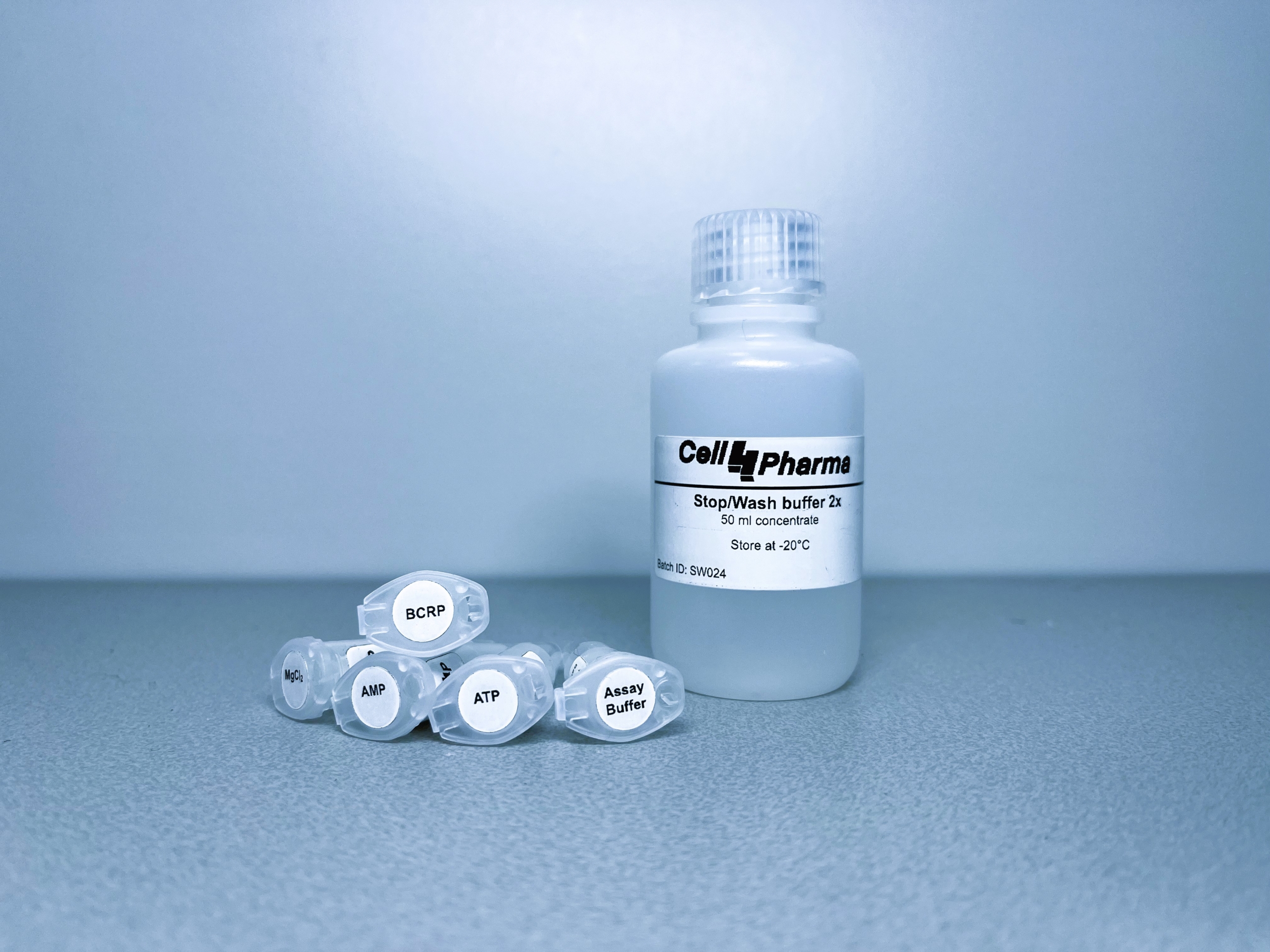
| Kit contents | Vesicles, ATP, AMP, reaction buffer, wash buffer, CoA |
| Manufacturer | Cell4Pharma (Netherlands) |
| Distributor DACH | SeamlessBio GmbH, Passau |
| Regulatory | Research Use Only (RUO) |
Applications
| Application | Description |
|---|---|
| Antiviral nucleotide analogue renal excretion | Nucleotide analogue antivirals — tenofovir, adefovir (PMEA), cidofovir — are MRP4 substrates at the renal proximal tubule apical membrane. MRP4 inhibition studies assess DDI risk for renal accumulation and nephrotoxicity in combination antiviral regimens, particularly where co-administered drugs (e.g. probenecid, NSAIDs) inhibit renal MRP4. |
| Renal DDI risk assessment | MRP4 mediates active tubular secretion of multiple drug classes into urine. Characterise whether an investigational compound is an MRP4 substrate or inhibitor to predict effects on renal clearance, identify renal accumulation risk, and support dose adjustment guidance for combination therapies. |
| Methotrexate and antifolate transport | MRP4 transports methotrexate and leucovorin in the renal proximal tubule. Co-administration of MRP4 inhibitors with high-dose methotrexate can impair tubular secretion, reducing methotrexate clearance and increasing systemic exposure — relevant for oncology and immunology combination therapy DDI assessment. |
| Prostaglandin and cyclic nucleotide efflux | Prostaglandins (PGE₁, PGE₂) and cyclic nucleotides (cAMP, cGMP) are endogenous MRP4 substrates. In platelets, MRP4-mediated cAMP efflux regulates platelet activation via thromboxane A₂ signalling — inhibition can alter platelet aggregation. Relevant for cardiovascular DDI profiling and anti-inflammatory drug development. |
| Urate excretion and gout DDI | MRP4 contributes to renal urate secretion. Drugs that inhibit MRP4-mediated urate efflux in the proximal tubule can raise serum urate levels, increasing gout risk in predisposed patients — particularly relevant for uricosuric drug development and DDI studies in patients with hyperuricaemia. |
Assay Principle
Inside-out membrane vesicles present the cytoplasmic face of MRP4 to the external assay buffer, allowing ATP-dependent substrate uptake into the vesicle lumen. Vesicles are incubated with test compound and probe substrate in the presence of ATP (active transport condition) or AMP (background control). The reaction is stopped with cold wash buffer; vesicles are separated by rapid filtration and intravesicular substrate is quantified by LC-MS/MS or radiolabel. The ATP/AMP uptake ratio — calculated against matched Human Control Vesicles — provides the assay window for IC₅₀ determination and substrate classification.
Complete Cell4Pharma Kit Portfolio
Order all ABC transporter vesicle kits from a single EU source — fast cold-chain delivery, guaranteed ATP/AMP ratios, full lot documentation.
| Kit | Transporter | Gene | ATP/AMP Ratio |
|---|---|---|---|
| Human BCRP Vesicle Kit | BCRP | ABCG2 | >10 |
| Human BSEP Vesicle Kit | BSEP | ABCB11 | >10 |
| Human MRP1 Vesicle Kit | MRP1 | ABCC1 | >5 |
| Human MRP2 Vesicle Kit | MRP2 | ABCC2 | >20 |
| Human MRP3 Vesicle Kit | MRP3 | ABCC3 | >5 |
| Human MRP4 Vesicle Kit | MRP4 | ABCC4 | >5 |
| Human MRP5 Vesicle Kit | MRP5 | ABCC5 | >5 |
| Human MRP8 Vesicle Kit | MRP8 | ABCC11 | >5 |
| Human P-gp Vesicle Kit | P-gp / MDR1 | ABCB1 | >5 |
| Human P-gp + FluoPgp Kit | P-gp / MDR1 | ABCB1 | >5 |
| Human Control Vesicle Kit | — | HEK293 empty vector | — |
Available Formats
| Format | Reactions |
|---|---|
| Kit | 100 reactions |
Key Benefits
Batch Reservation
Reserve validated lots up to 36 months for reproducible long-term DDI study workflows.
Full Documentation
Lot-specific QC report and data sheet included with every kit — from ISO 9001 and ISO 13485 certified partner facilities.
EU & Swiss Supply
Manufactured by Cell4Pharma (Netherlands) — fast cold-chain delivery across EU, UK and Switzerland.
Frequently Asked Questions
Is MRP4 relevant for specific drug classes in DDI submissions?
Yes — MRP4 (ABCC4) is most important for three drug classes: (1) nucleotide analogue antivirals (tenofovir, adefovir, cidofovir), where renal MRP4 mediates tubular secretion and inhibition can cause nephrotoxic accumulation; (2) antifolates and cytotoxics (methotrexate, leucovorin), where MRP4 inhibition reduces renal clearance and increases systemic exposure; and (3) NSAIDs and COX inhibitors, which can inhibit MRP4-mediated prostaglandin efflux and alter renal and platelet physiology. MRP4 is not currently a primary Tier 1 DDI transporter under FDA (2020) or EMA (2022) guidance, but it is routinely included in extended renal transporter panels alongside OAT1, OAT3, and OCT2 for the drug classes above.
What probe substrates and inhibitors are used in MRP4 vesicular transport assays?
The most commonly used radiolabelled probe substrates for MRP4 (ABCC4) vesicular transport assays are [³H]-PMEA (adefovir dipivoxil precursor) and [³H]-methotrexate; unlabelled cAMP and estradiol-17β-D-glucuronide (E217βG) are also used with LC-MS/MS detection. For inhibition studies, reference inhibitors include MK571 (pan-MRP inhibitor), probenecid, dipyridamole, and the selective MRP4 inhibitor ceefourin-1. The Cell4Pharma kit protocol provides lot-specific recommendations for probe substrate concentration and incubation conditions to achieve the guaranteed ATP/AMP ratio of >5.
How does MRP4 contribute to antiviral nephrotoxicity, and how does the vesicle assay help?
Nucleotide analogue antivirals such as tenofovir and adefovir are renally excreted primarily via active tubular secretion, which requires uptake from blood into the tubular cell (mediated by OAT1/OAT3 at the basolateral membrane) followed by efflux into urine (mediated by MRP4 at the apical membrane). When MRP4 is inhibited — by a co-administered drug or by the antiviral itself at high doses — the drug accumulates intracellularly in proximal tubule cells, causing mitochondrial toxicity and nephrotoxicity. The MRP4 vesicle assay quantifies the IC₅₀ of a test compound for MRP4-mediated efflux of probe substrate (e.g. PMEA), enabling DDI risk assessment and informing whether dose adjustment or renal monitoring is warranted in combination regimens.
Why is MRP4 relevant in platelet biology and cardiovascular DDI studies?
MRP4 (ABCC4) is expressed at high levels in platelets, where it mediates efflux of cAMP and thromboxane B₂. Intracellular cAMP in platelets acts as an inhibitory second messenger, suppressing platelet activation and aggregation — MRP4 efflux reduces intracellular cAMP, thereby supporting the platelet activation threshold. Inhibition of platelet MRP4 by drugs such as dipyridamole raises intracellular cAMP and inhibits platelet aggregation, contributing to the antiplatelet mechanism of this compound class. For investigational drugs where platelet effects or cardiovascular DDI are a concern, including MRP4 in the transporter profiling panel helps characterise this mechanism.
What documentation is supplied with the Human MRP4 Vesicle Kit?
Every kit shipment includes a lot-specific QC report confirming the ATP/AMP transport ratio (>5) and vesicle preparation parameters, and a data sheet with recommended assay conditions, probe substrates, and reference inhibitor concentrations. All Cell4Pharma kits are manufactured under ISO 9001 and ISO 13485 certified quality systems. Batch reservation for up to 36 months is available on request — particularly important for multi-transporter renal DDI panels where lot-to-lot consistency between the MRP4 kit and matched Control Vesicle Kit must be maintained across the full study duration.
Request a Quote or Sample
48h response · EU & Swiss Supply · Batch reservation available · Full documentation
 English
  Deutsch