
Description
Product Overview
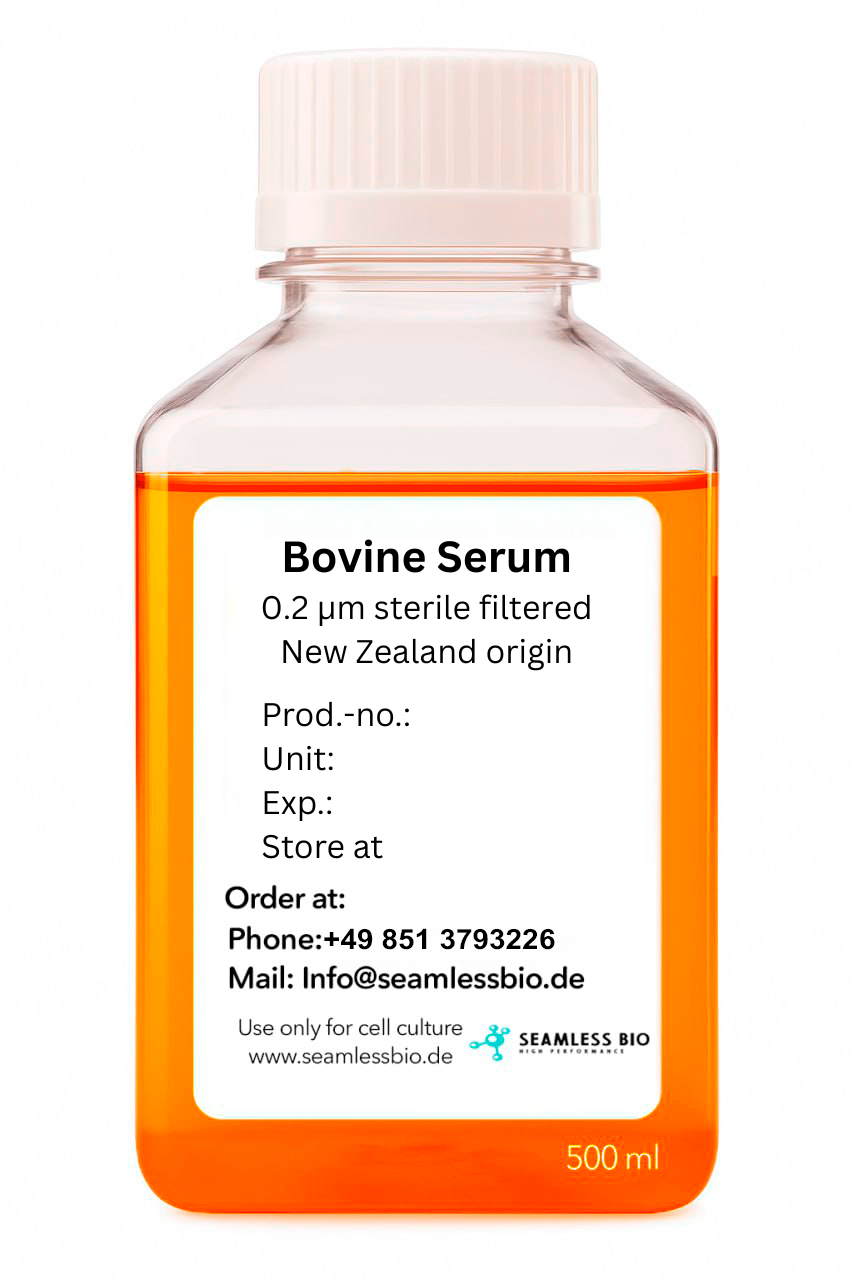
SeamlessBio Adult Bovine Serum (ABS) — New Zealand Origin is collected from healthy cattle aged 12–36 months under strict aseptic conditions, naturally coagulated and centrifuged to yield high-quality serum. New Zealand has never recorded a single confirmed BSE case in its history, holds full OIE certification, and is regulated by the Ministry for Primary Industries (MPI) — making it the preferred bovine origin for pharmaceutical and vaccine manufacturing where TSE risk must be minimised. The serum is sterile filtered at 0.2 µm as standard; triple 0.1 µm filtration (SAL 10⁻³) is available on request for GMP-critical workflows. Accepted by EMA, FDA, PMDA and TGA. CEP (EDQM) available on request.
Technical Specifications
| Parameter | Specification |
|---|---|
| Origin | New Zealand — OIE certified, no BSE ever recorded |
| Animal age | 12–36 months |
| Collection method | Aseptic blood collection, natural coagulation, centrifugation |
| Filtration (standard) | 0.2 µm sterile filtered |
| Filtration (premium) | Triple 0.1 µm sterile filtered (on request) — SAL 10⁻³ |
| Sterility | No growth — Ph. Eur. 2.6.1 |
| Mycoplasma | Negative (PCR + NAT) |
| Endotoxin (LAL) | ≤10 EU/mL |
| Virus testing | BVD, BHV-1, BPV, Bovine Adenovirus — all negative |
| Haemoglobin | ≤200 mg/L |
| pH (37 °C) | 7.0–8.0 |
| TSE/BSE status | Never recorded — OIE certified; Ph. Eur. 5.2.8 compliant |
| Regulatory authority | MPI (Ministry for Primary Industries, New Zealand) |
| Accepted by | EMA, FDA, PMDA, TGA |
| CEP (EDQM) | Available on request |
| Storage | −20 °C long-term / +4 °C in use |
| Shelf life | 3 years from production date |
| Regulatory | Research Use Only (RUO) |
Applications
| Application | Description |
|---|---|
| Vaccine production & virology | Vero & MDCK substrate cell lines, virus propagation and titre optimisation, pre-clinical vaccine development, potency assays and quality control |
| Biopharmaceutical manufacturing | Recombinant protein production (CHO, HEK293), monoclonal antibody production, GMP-compliant bioprocesses, therapeutic protein purification |
| Routine cell culture | Maintenance of adherent cell lines, fibroblast and epithelial cell culture, cell banking and cryopreservation — cost-effective alternative to FBS for robust established cell lines |
| Regulatory & clinical applications | IND/CTA submissions (EMA, FDA), clinical GMP production, diagnostics development and validation, Phase I/II/III trial substrates |
Documentation
Every lot ships with a Certificate of Analysis (CoA), Safety Data Sheet (SDS), sterility report (Ph. Eur. 2.6.1), mycoplasma test report (PCR + NAT), virus testing results (BVD, BHV-1, BPV, Bovine Adenovirus), endotoxin certificate (LAL), and TSE/BSE compliance documentation (Ph. Eur. 5.2.8) — from ISO 9001 and ISO 13485 certified partner facilities. Available on request: CEP (EDQM Certificate of Suitability), Health Certificate (MPI New Zealand), and Certificate of Origin (CoO).
Storage & Handling
Store long-term at −20 °C; transfer to +4 °C for active use. Limit freeze-thaw cycles to a maximum of 3–4. Thaw overnight at 2–8 °C. Aliquot into working volumes after the first thaw to minimise further cycling. Equilibrate to 37 °C before adding to cell culture medium.
Available Formats
| Format | Size |
|---|---|
| Bottle | 50 mL |
| Bottle | 100 mL |
| Bottle | 500 mL |
| Bottle | 1000 mL |
| Bulk | On request |
Key Benefits
Batch Reservation
Reserve validated lots up to 36 months for reproducible long-term cell culture and bioprocessing workflows.
Full Documentation
CoA, CoO and SDS — from ISO 9001 and ISO 13485 certified partner facilities. CEP (EDQM) and Health Certificate available on request.
EU & Swiss Supply
Sourced from certified EU partner facilities — fast cold-chain delivery across EU, UK and Switzerland.
Frequently Asked Questions
What is the difference between Adult Bovine Serum (ABS) and Fetal Bovine Serum (FBS)?
ABS is collected from cattle aged 12–36 months and contains higher immunoglobulin (IgG) concentrations with lower growth factor levels than FBS. It is more economical and well-suited for robust, established cell lines that do not require the mitogenic richness of fetal serum. FBS is collected from bovine fetuses and delivers the highest growth factor content with minimal IgG — the standard choice for demanding primary cells, sensitive differentiation assays, and cell types with high growth requirements. For most routine culture of established lines, ABS is a reliable and cost-effective supplement.
Why is New Zealand origin preferred for pharmaceutical and vaccine production?
New Zealand has never recorded a single confirmed BSE case in its history — an unmatched record among all major cattle-producing countries. The national herd operates under strict MPI (Ministry for Primary Industries) regulation with full traceability from animal to final product, and holds OIE certification confirming its TSE/BSE-free status. EMA, FDA, PMDA and TGA all recognise New Zealand-origin bovine material under the lowest possible TSE risk classification, substantially simplifying IND, MAA and CTA filings compared to serum from regions with historic BSE exposure.
What is triple 0.1 µm filtration and when is it required?
Triple 0.1 µm filtration passes the serum through three sequential membrane filtration steps in an ISO Class 5 cleanroom environment, achieving a Sterility Assurance Level (SAL) of 10⁻³ — one order of magnitude beyond standard 0.2 µm sterile filtration. This is recommended for GMP bioproduction, vaccine manufacturing, cell therapy manufacturing, and any process where regulatory guidance or internal SOPs require maximum bioburden reduction and complete documentation. Standard 0.2 µm filtration is fully adequate for the vast majority of research and development applications.
Is a CEP (EDQM Certificate of Suitability) available for New Zealand Bovine Serum?
Yes — a Certificate of Suitability (CEP) from the European Directorate for the Quality of Medicines (EDQM) is available on request. The CEP confirms that the product meets the relevant European Pharmacopoeia monograph requirements and provides regulators with an independent compliance assessment, significantly reducing the documentation burden for EU Marketing Authorisation Applications (MAA) and Clinical Trial Applications (CTA) that reference this serum as a raw material.
How does batch reservation work, and why is it especially important for New Zealand origin?
New Zealand bovine serum is produced in accordance with seasonal calving cycles, which limits the number of production lots available in any given year — particularly for larger volumes. We recommend requesting a 50–100 mL sample for internal qualification testing, then reserving a dedicated lot once the batch has been validated in your system. Lot reservation is available for up to 36 months, with phased deliveries scheduled to match your project timeline and cold-storage capacity. Early contact is strongly recommended for volumes exceeding 10 litres or for long-term clinical or GMP programmes.
Request a Quote or Sample
48h response · EU & Swiss Supply · Batch reservation available · CEP (EDQM) on request
 English
  Deutsch