
Description
Product Overview
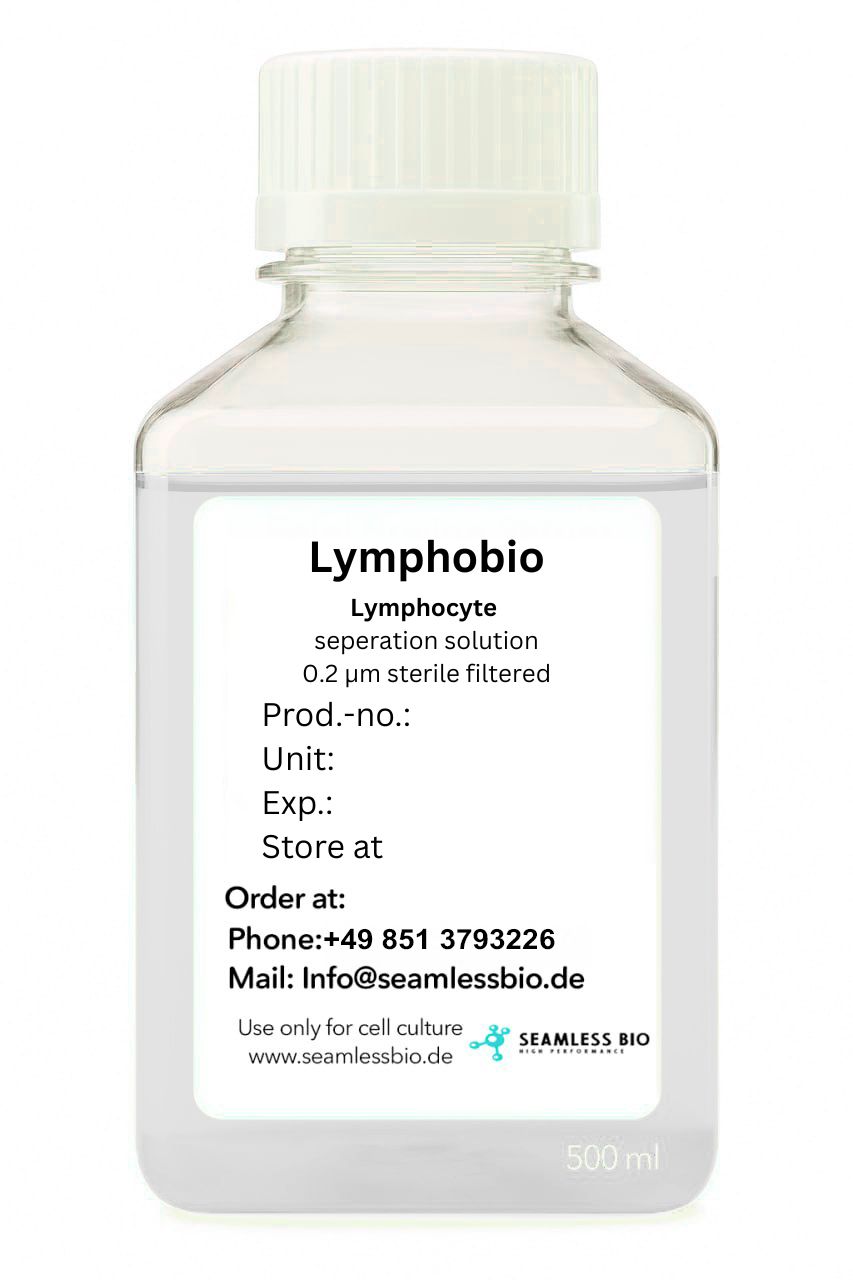
Lymphobio — Lymphocyte Separation Solution is a ready-to-use density gradient medium based on highly purified, cross-linked polysucrose (average MW ~400,000 Da), formulated at a density of 1.077 ± 0.001 g/mL. It is designed for the isolation of peripheral blood mononuclear cells (PBMCs) from whole blood by density gradient centrifugation — the gold-standard method for separating lymphocytes and monocytes from erythrocytes, granulocytes, and platelets in a single centrifugation step. Lymphobio is sterile filtered at 0.2 µm, endotoxin tested (<0.25 EU/mL), and ready to use without dilution or preparation.
Technical Specifications
| Parameter | Specification |
|---|---|
| Density | 1.077 ± 0.001 g/mL (at 20 °C) |
| Base material | Polysucrose — highly purified, cross-linked |
| Molecular weight | ~400,000 Da (average) |
| Osmolality | 290 ± 15 mOsm/kg |
| pH | 7.0 ± 0.3 |
| Endotoxin | <0.25 EU/mL |
| Sterility | 0.2 µm sterile filtered |
| Storage | 2–8 °C, protected from light — do not freeze |
| Shelf life | 24 months from production date |
| Article numbers | SBS-LYM-100 (100 mL) | SBS-LYM-500 (500 mL) |
| Formats | 100 mL, 500 mL; bulk on request |
| Regulatory | Research Use Only (RUO) |
How Density Gradient Centrifugation Works
At 1.077 g/mL, Lymphobio creates a density barrier that separates blood components by their buoyant density during centrifugation at 400 × g for 30–40 minutes (brake off). Mononuclear cells (density 1.065–1.077 g/mL) accumulate at the interface between the gradient medium and the plasma layer. Erythrocytes and granulocytes (density >1.080 g/mL) pellet through the medium to the bottom. Plasma and platelets (density <1.065 g/mL) remain in the upper layer. The buffy coat at the interface is harvested and washed to yield PBMCs at >95% viability and 1–2 × 10⁶ cells per mL of whole blood.
Standard Protocol
| Step | Action | Note |
|---|---|---|
| 1. Sample preparation | Dilute whole blood 1:1 with PBS or physiological saline | EDTA, heparin, or citrate-anticoagulated blood; avoid clotted samples |
| 2. Layering | Carefully overlay diluted blood onto Lymphobio in a centrifuge tube | Do not mix layers — pipette slowly down the tube wall |
| 3. Centrifugation | 400 × g, 30–40 min, room temperature, brake off | Brake-off essential — braking disrupts the gradient interface |
| 4. PBMC harvest | Collect the white buffy coat layer at the plasma/medium interface | Use a wide-bore pipette; avoid disturbing the medium below |
| 5. Washing | Resuspend in PBS, centrifuge 2× at 200–300 × g to remove residual medium | Two wash steps remove platelets and residual polysucrose |
| 6. Downstream use | Resuspend in appropriate buffer or medium for downstream application | Count and assess viability before proceeding |
Applications
| Application | Downstream workflow |
|---|---|
| Immunology research | T cell and B cell functional assays, NK cell cytotoxicity, dendritic cell isolation, macrophage polarization, cytokine profiling (ELISA, multiplex) |
| Flow cytometry and FACS | PBMC immunophenotyping, cell sorting (T cells, B cells, monocytes), intracellular cytokine staining, activation marker analysis (CD69, CD25), apoptosis and proliferation assays |
| Molecular biology | Gene expression analysis (qPCR, RNA-seq), DNA/RNA extraction, epigenetic studies (ChIP, ATAC-seq), single-cell sequencing (scRNA-seq), CRISPR/Cas9 editing in primary immune cells |
| Drug discovery and immunotoxicology | Immunotoxicity screening, drug response profiling in primary human immune cells, ADCC/CDC antibody efficacy testing, CAR-T cell production and testing, vaccine immunogenicity studies |
| Clinical diagnostics | HIV viral load monitoring, tuberculosis diagnostics (QuantiFERON), autoimmune disease marker panels, transplant rejection monitoring, cancer immunotherapy response tracking |
Available Formats
| Format | Article No. | Size |
|---|---|---|
| Bottle | SBS-LYM-100 | 100 mL |
| Bottle | SBS-LYM-500 | 500 mL |
| Bulk | On request | On request |
Key Benefits
Batch Reservation
Reserve validated lots up to 36 months for reproducible long-term PBMC isolation and immunology workflows.
Full Documentation
CoA, endotoxin test report and SDS — from ISO 9001 and ISO 13485 certified partner facilities. Additional documents on request.
EU & Swiss Supply
Sourced from certified EU partner facilities — fast delivery across EU, UK and Switzerland.
Frequently Asked Questions
What is Lymphobio and how does it differ from Ficoll-Paque?
Lymphobio is a polysucrose-based density gradient medium formulated at 1.077 g/mL for PBMC isolation — functionally equivalent to Ficoll-Paque and Histopaque-1077. All three products are based on cross-linked polysucrose at the same target density and operate on the same density gradient centrifugation principle. The separation mechanism, protocol steps, and expected cell yield are identical. Lymphobio provides the same performance as established Ficoll-based reagents, supplied from certified EU partner facilities with full lot documentation, making it a direct drop-in replacement for laboratories seeking an alternative source with EU supply chain and reliable batch-to-batch consistency.
What PBMC yield and viability can be expected from Lymphobio?
Typical yield from healthy donors is 1–2 × 10⁶ PBMCs per mL of whole blood, with cell viability consistently >95% as assessed by trypan blue exclusion. Yield varies with donor health, blood collection conditions, and time between collection and processing. For optimal results, process anticoagulated blood within 4–6 hours of collection at room temperature. Blood stored at 4 °C can be processed within 24 hours, though viability may decline slightly. The low-endotoxin formulation (<0.25 EU/mL) and iso-osmotic conditions (290 ± 15 mOsm/kg) minimise osmotic stress and preserve cell functional integrity for downstream assays.
Which anticoagulants are compatible with Lymphobio?
Lymphobio is compatible with EDTA-, heparin-, and citrate-anticoagulated whole blood. EDTA and heparin are the most commonly used anticoagulants for PBMC isolation and both give reliable results. Citrate-anticoagulated blood (e.g., from blood bank collection bags) is also compatible. Clotted blood is not suitable — fibrin clot formation traps mononuclear cells and significantly reduces yield. ACD (acid citrate dextrose) anticoagulant is also compatible and is particularly used in clinical and apheresis settings. The dilution step (1:1 with PBS before layering) is recommended regardless of anticoagulant type to reduce blood viscosity and improve interface clarity.
Can Lymphobio be used with automated PBMC isolation systems?
Yes — Lymphobio is compatible with automated density gradient centrifugation systems including Sepax (Cytiva), Accuspin tubes (Sigma-Aldrich), and SepMate tubes (STEMCELL Technologies). For Accuspin and SepMate formats, the standard protocol is adapted: Lymphobio is loaded into the frit or insert, diluted blood is added directly on top, and centrifugation proceeds with brake on at the system-specified speed. For fully automated closed-system processing (Sepax), consult the system-specific protocol for volume ratios and centrifugation parameters. Lymphobio can also be density-adjusted up to 1.2 g/mL with sterile water or concentrated stock for specialized separations such as subcellular particle isolation or granulocyte-enriched fractions.
What documentation is supplied with Lymphobio, and is batch reservation available?
Every order includes a Certificate of Analysis (CoA) with density, osmolality, pH, endotoxin, and sterility results, and a Safety Data Sheet (SDS). Additional documentation — including detailed sterility test reports and origin declarations — is available on request. Products are handled at ISO 9001 and ISO 13485 certified partner facilities. Batch reservation for up to 36 months is available on request: for long-term immunology studies, clinical trial sample processing, or diagnostic assay development where lot-to-lot consistency must be maintained across multiple isolation runs, we will hold the validated lot under controlled refrigerated storage until your delivery schedule is confirmed.
Request a Quote or Sample
48h response · EU & Swiss Supply · Batch reservation available · Full documentation
 English
  Deutsch