
Beschreibung
Produktübersicht
Die Humanes MRP3-Vesikel-Kit (HEK293) liefert gebrauchsfertige Inside-out-Membranvesikel mit Überexpression von humanem MRP3 (ABCC3) für ATP-abhängige vesikuläre Transportstudien. MRP3 sitzt an der basolateralen (sinusoidalen) Membran der Hepatozyten – auf der gegenüberliegenden Seite von kanalikulärem BSEP und MRP2 – und pumpt Glucuronidkonjugate und monovalente Gallensäuren aus dem Hepatozyten ins sinusoidale Blut. Damit ist MRP3 ein Schlüsselfaktor für die hepatische Wirkstoffdisposition und der wichtigste Überlaufweg für Gallensäuren bei Cholestase.
Garantiertes ATP/AMP-Transportverhältnis > 5 je Charge. Verwenden Sie es zusammen mit den Kit für Human-Kontrollvesikel zur passenden Hintergrundkorrektur – erforderlich für DDI-Daten in regulatorischer Qualität gemäß FDA-DDI-Leitlinie (2020) und EMA-DDI-Leitlinie (2013/2022).
Transporterprofil
| Eigenschaft | Detail |
|---|---|
| Transportername | MRP3 – Multidrug Resistance-Associated Protein 3 |
| Gen | ABCC3 |
| Proteinfamilie | ABC-Transporter, ABCC-Unterfamilie |
| Membranlokalisation | Basolaterale (sinusoidale) Membran der Hepatozyten; außerdem Darmepithel, Niere |
| Wichtige Substrate | Glucuronidkonjugate, monoanionische Gallensalze, Methotrexat, Etoposid |
| Inhibitoren (Referenz) | MK571, Probenecid |
| DDI-Relevanz | Hepatischer Metaboliten-Efflux, cholestatischer Gallensäure-Überlauf, intestinaler Transport von Phase-II-Metaboliten, enterohepatischer Kreislauf |
| Kompensatorische Rolle | MRP3 wird kompensatorisch hochreguliert, wenn die kanalikuläre BSEP-vermittelte Sekretion beeinträchtigt ist |
Technische Daten
| Parameter | Spezifikation |
|---|---|
| Transporter | Humanes MRP3 (Multidrug Resistance-Associated Protein 3) (ABCC3) |
| Expressionssystem | HEK293 (transiente Überexpression) |
| Vesikeltyp | Inside-out-Membranvesikel |
| Reaktionen pro Kit | 100 |
| ATP/AMP-Transportverhältnis | > 5 (je Charge garantiert) |
| Detektionskompatibilität | Radiolabel, LC-MS/MS |
| Lagerung | −80 °C (Versand auf Trockeneis) |
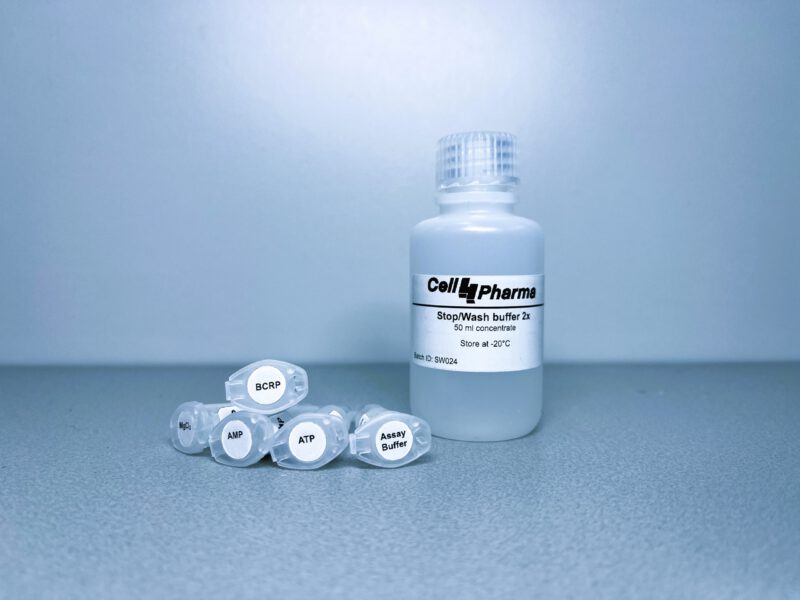
| Kit-Inhalt | Vesikel, ATP, AMP, Reaktionspuffer, Waschpuffer, CoA |
| Hersteller | Cell4Pharma (Niederlande) |
| Vertrieb DACH | SeamlessBio GmbH, Passau |
| Regulatorisch | Nur für Forschungszwecke (RUO) |
Anwendungen
| Anwendung | Beschreibung |
|---|---|
| Profiling des hepatischen basolateralen Efflux | Charakterisieren Sie den MRP3-vermittelten sinusoidalen Export von Glucuronidkonjugaten – relevant zur Vorhersage der hepatischen Wirkstoffanreicherung und der systemischen Exposition von Phase-II-Metaboliten. Besonders wichtig für Substanzen mit ausgeprägter hepatischer Glucuronidierung, bei denen das Schicksal der Metaboliten die Gesamt-PK bestimmt. |
| Cholestasebezogener Gallensäuretransport | Bewerten Sie den Gallensäure-Überlauf über MRP3 als Kompensationsmechanismus bei beeinträchtigter kanalikulärer BSEP-Sekretion. Relevant für DDI-Studien mit BSEP-Inhibitoren und für das Verständnis des hepatotoxischen Risikos von Substanzen, die die Gallensäurehomöostase stören. |
| Interaktionspanel BSEP/MRP3 | MRP3 und BSEP sind funktionelle Gegenspieler im hepatischen Gallensäurehaushalt. MRP3 zusammen mit BSEP und MRP2 in einem Cholestase-DDI-Panel liefert ein vollständiges Bild des Gallensäureflusses im Hepatozyten und zeigt, ob Substanzen, die BSEP hemmen, auch das „Sicherheitsventil“ MRP3 unterdrücken. |
| Studien zum intestinalen Wirkstoff-Efflux | MRP3 an der basolateralen Membran des Darms trägt zum mukosal-serosalen Transport von Phase-II-Metaboliten bei. Relevant für Substanzen mit ausgeprägter intestinaler Glucuronidierung, bei denen der basolaterale Efflux die orale Bioverfügbarkeit der Metaboliten und den enterohepatischen Kreislauf bestimmt. |
| Transport von Methotrexat und Zytostatika | MRP3 transportiert Methotrexat und Etoposid – Zytostatika, bei denen hepatischer und intestinaler Efflux Gewebeexposition und systemische Clearance beeinflussen. Relevant für die DDI-Bewertung von Prüfsubstanzen, die zusammen mit Methotrexat-basierten Chemotherapien gegeben werden. |
Assay-Prinzip
Inside-out-Membranvesikel präsentieren die zytoplasmatische Seite von MRP3 zum äußeren Assaypuffer und ermöglichen die ATP-abhängige Aufnahme des Substrats ins Vesikellumen. Die Vesikel werden mit Testsubstanz und Sondensubstrat in Gegenwart von ATP (aktiver Transport) oder AMP (Hintergrundkontrolle) inkubiert. Die Reaktion wird mit kaltem Waschpuffer gestoppt, die Vesikel werden per Schnellfiltration abgetrennt und das intravesikuläre Substrat per LC-MS/MS oder Radiolabel quantifiziert. Das ATP/AMP-Aufnahmeverhältnis – berechnet gegen passende humane Kontrollvesikel – bildet das Assayfenster für die IC₅₀-Bestimmung und die Substratklassifizierung.
Gesamtes Kit-Portfolio von Cell4Pharma
Alle ABC-Transporter-Vesikel-Kits aus einer EU-Quelle bestellen – schnelle Lieferung in der Kühlkette, garantierte ATP/AMP-Verhältnisse, vollständige Chargendokumentation.
| Bausatz | Transporter | Gen | ATP/AMP-Verhältnis |
|---|---|---|---|
| Kit für menschliche BCRP-Vesikel | BCRP | ABCG2 | >10 |
| BSEP-Vesikel-Kit für den Menschen | BSEP | ABCB11 | >10 |
| MRP1-Vesikel-Kit für den Menschen | MRP1 | ABCC1 | >5 |
| MRP2-Vesikel-Kit für den Menschen | MRP2 | ABCC2 | >20 |
| MRP3-Vesikel-Kit für den Menschen | MRP3 | ABCC3 | >5 |
| MRP4-Vesikel-Kit für den Menschen | MRP4 | ABCC4 | >5 |
| MRP5-Vesikel-Kit für den Menschen | MRP5 | ABCC5 | >5 |
| MRP8-Vesikel-Kit (menschlich) | MRP8 | ABCC11 | >5 |
| Kit für menschliche P-gp-Vesikel | P-gp / MDR1 | ABCB1 | >5 |
| Humanes P-gp + FluoPgp-Kit | P-gp / MDR1 | ABCB1 | >5 |
| Kit für Human-Kontrollvesikel | — | HEK293 Leervektor | — |
Verfügbare Formate
| Format | Reaktionen |
|---|---|
| Bausatz | 100 Reaktionen |
Die wichtigsten Vorteile
Sammelreservierung
Validierte Chargen bis zu 36 Monate reservieren – für reproduzierbare Langzeit-DDI-Studien.
Vollständige Dokumentation
Chargenspezifischer QC-Bericht und Datenblatt bei jedem Kit – aus nach ISO 9001 und ISO 13485 zertifizierten Partnerwerken.
Lieferung EU & Schweiz
Hergestellt von Cell4Pharma (Niederlande) – schnelle Lieferung in der Kühlkette in die EU, nach Großbritannien und in die Schweiz.
Häufig gestellte Fragen
Wann sollte MRP3 in ein Transporterpanel aufgenommen werden?
MRP3 ist vor allem in drei Szenarien wertvoll: (1) Substanzen mit ausgeprägter hepatischer Glucuronidierung, bei denen der sinusoidale Exportweg der Glucuronidmetaboliten und ihre systemische Exposition verstanden werden müssen; (2) BSEP-Inhibitoren, bei denen der cholestatische Gallensäure-Überlauf über MRP3 der wichtigste Kompensationsmechanismus ist und zur Bewertung des Netto-Hepatotoxizitätsrisikos charakterisiert werden muss; (3) Substanzen mit ausgeprägtem enterohepatischem Kreislauf, bei denen intestinales MRP3 den mukosal-serosalen Transport von Phase-II-Metaboliten beeinflusst. MRP3 wird außerdem aufgenommen, wenn die Substanz strukturell bekannten MRP3-Substraten wie Methotrexat, Etoposid oder monoanionischen Gallensalzen ähnelt.
Wie hängen MRP3 und BSEP in Cholestase-DDI-Studien zusammen?
BSEP (ABCB11) und MRP3 (ABCC3) ergänzen sich im hepatischen Gallensäurehaushalt. Normalerweise vermittelt BSEP die kanalikuläre Sekretion konjugierter Gallensäuren in die Galle. Ist die BSEP-Funktion beeinträchtigt – durch Arzneimittelhemmung oder genetische Varianten –, reichern sich Gallensäuren intrazellulär an und führen zur Hochregulation von MRP3 an der basolateralen Membran, das den Gallensäure-Efflux als kompensatorischen Überlauf ins sinusoidale Blut umleitet. In BSEP-DDI-Studien ist es daher wichtig, MRP3 mitzuerfassen: Eine Substanz, die BSEP stark hemmt und zugleich MRP3 hemmt, blockiert beide Exportwege und erhöht die Gallensäureanreicherung im Hepatozyten und das Risiko cholestatischer Schäden erheblich. Beide Assays parallel liefern ein vollständigeres Bild des hepatischen Netto-Gallensäureflusses.
Welche Substrate und Sondensubstrate werden in vesikulären MRP3-Transportassays verwendet?
Gut charakterisierte MRP3-Substrate (ABCC3) für vesikuläre Transportassays sind Estradiol-17β-D-glucuronid (E217βG) – das meistverwendete radioaktiv markierte Sondensubstrat – sowie Taurolithocholat-3-sulfat (TLCS), Methotrexat, Etoposidglucuronid und monoanionische Gallensäuren wie Glykocholat. Für Inhibitionsstudien sind MK571 (Pan-MRP-Inhibitor) und Probenecid Referenzinhibitoren. Das Kit-Protokoll von Cell4Pharma enthält chargenspezifische Empfehlungen zu Substratkonzentration und Inkubationsbedingungen, um das garantierte ATP/AMP-Verhältnis von > 5 zu erreichen.
Wie unterscheidet sich MRP3 von MRP2, und warum sind beide in hepatischen DDI-Panels relevant?
MRP2 (ABCC2) und MRP3 (ABCC3) überschneiden sich stark im Substratspektrum – beide transportieren Glucuronidkonjugate und Gallensalze –, sitzen aber auf gegenüberliegenden Seiten des Hepatozyten. MRP2 liegt an der kanalikulären (apikalen) Membran und treibt die Sekretion in die Galle, MRP3 an der basolateralen (sinusoidalen) Membran und leitet Substrate in den Pfortaderkreislauf. Durch diese gegensätzliche Polarität konkurrieren beide Transporter um denselben hepatozellulären Substratpool und bestimmen gemeinsam, ob ein Glucuronidkonjugat über die Galle oder das Blut austritt. Für die DDI-Bewertung hepatisch glucuronidierter Substanzen liefert die Charakterisierung der MRP2-vermittelten biliären Ausscheidung und des MRP3-vermittelten sinusoidalen Efflux das vollständige Bild der hepatischen Clearancewege und der systemischen Metabolitenexposition.
Welche Dokumentation erhalte ich zum Humanen MRP3-Vesikel-Kit?
Jeder Kit-Lieferung liegen ein chargenspezifischer QC-Bericht, der das ATP/AMP-Transportverhältnis (> 5) und die Parameter der Vesikelpräparation bestätigt, sowie ein Datenblatt mit empfohlenen Assaybedingungen, Sondensubstraten und Konzentrationen der Referenzinhibitoren bei. Alle Kits von Cell4Pharma werden unter nach ISO 9001 und ISO 13485 zertifizierten Qualitätssystemen hergestellt. Chargenreservierung bis zu 36 Monate auf Anfrage – besonders wichtig für Multitransporter-DDI-Panels, in denen MRP3-Kit und passendes Kontrollvesikel-Kit über die gesamte Studiendauer chargengleich bleiben müssen.
Angebot oder Muster anfordern
Antwort in 48 h · Lieferung EU & Schweiz · Chargenreservierung möglich · Vollständige Dokumentation

 English
  Deutsch