
Beschreibung
Product Overview
The Cell4Pharma Human BSEP Vesicle Kit (C4PVK-BSEP) provides inside-out membrane vesicles isolated from HEK293 cells transiently overexpressing the Bile Salt Export Pump (BSEP / ABCB11). BSEP is the primary canalicular efflux transporter for conjugated bile salts in hepatocytes — its inhibition by drugs is a well-established mechanism of drug-induced cholestatic liver injury (DILI). The kit enables ATP-dependent taurocholate transport studies and inhibition assays in a high-throughput format compatible with radiolabel, fluorescent, and LC-MS/MS detection. It is designed for BSEP inhibition assessment and DILI risk characterization in accordance with FDA Drug Interaction Guidance (2017) and EMA Guideline on the Investigation of Drug Interactions (2013). Kit size: 100 Reaktionen. Also available: cat and dog BSEP vesicle kits for comparative species studies. Manufactured by Cell4Pharma; available exclusively in the DACH region via SeamlessBio.
Transporter Profile
| Parameter | Details |
|---|---|
| Transporter name | BSEP — Bile Salt Export Pump |
| Synonyms | ABCB11, Sister of P-glycoprotein (SPGP), ATP-binding cassette sub-family B member 11 |
| Gen | ABCB11 |
| Transporter family | ABC (ATP-binding cassette) — efflux transporter, full-transporter |
| ATP/AMP-Verhältnis | >10 (guaranteed) |
| Tissue expression | Canalicular plasma membrane of hepatocytes (liver-exclusive expression) |
| Known substrates | Taurocholate (TCA), taurochenodeoxycholate, glycocholate, taurolitocholate-3-sulfate (TLCS), pravastatin, conjugated monovalent bile salts |
| Known inhibitors | Cyclosporin A, bosentan, troglitazone, glibenclamide, rifampicin |
| Disease relevance | Inherited cholestasis (PFIC2, BRIC2); drug-induced cholestatic DILI — primary BSEP inhibition mechanism |
| Regulatory relevance | FDA (2017) and EMA (2013) DDI guidance — BSEP inhibition assessment recommended for hepatotoxic DILI risk characterization |
Technische Daten
| Parameter | Spezifikation |
|---|---|
| Host cell | HEK293 (human embryonic kidney) — transient overexpression |
| Vesicle type | Inside-out membrane vesicles |
| Kit size | 100 reactions per kit |
| ATP/AMP-Verhältnis | >10 (lot-specific, guaranteed) |
| Detection compatibility | Radiolabel (³H/¹⁴C), fluorescent substrates, LC-MS/MS |
| Assay format | Vesicular transport assay — high-throughput compatible (96-well format) |
| Species variants | Human BSEP (C4PVK-BSEP); cat BSEP; dog BSEP — available on request |
| Recommended control | Human Control Vesicle Kit (C4PVK009) — negative control |
| Lagerung | −80 °C |
| Manufacturer | Cell4Pharma |
| DACH distributor | SeamlessBio (exclusive) |
Kit Contents
| Komponente | Details |
|---|---|
| Vesicle vial | BSEP-overexpressing HEK293-derived inside-out membrane vesicles — 100 reactions |
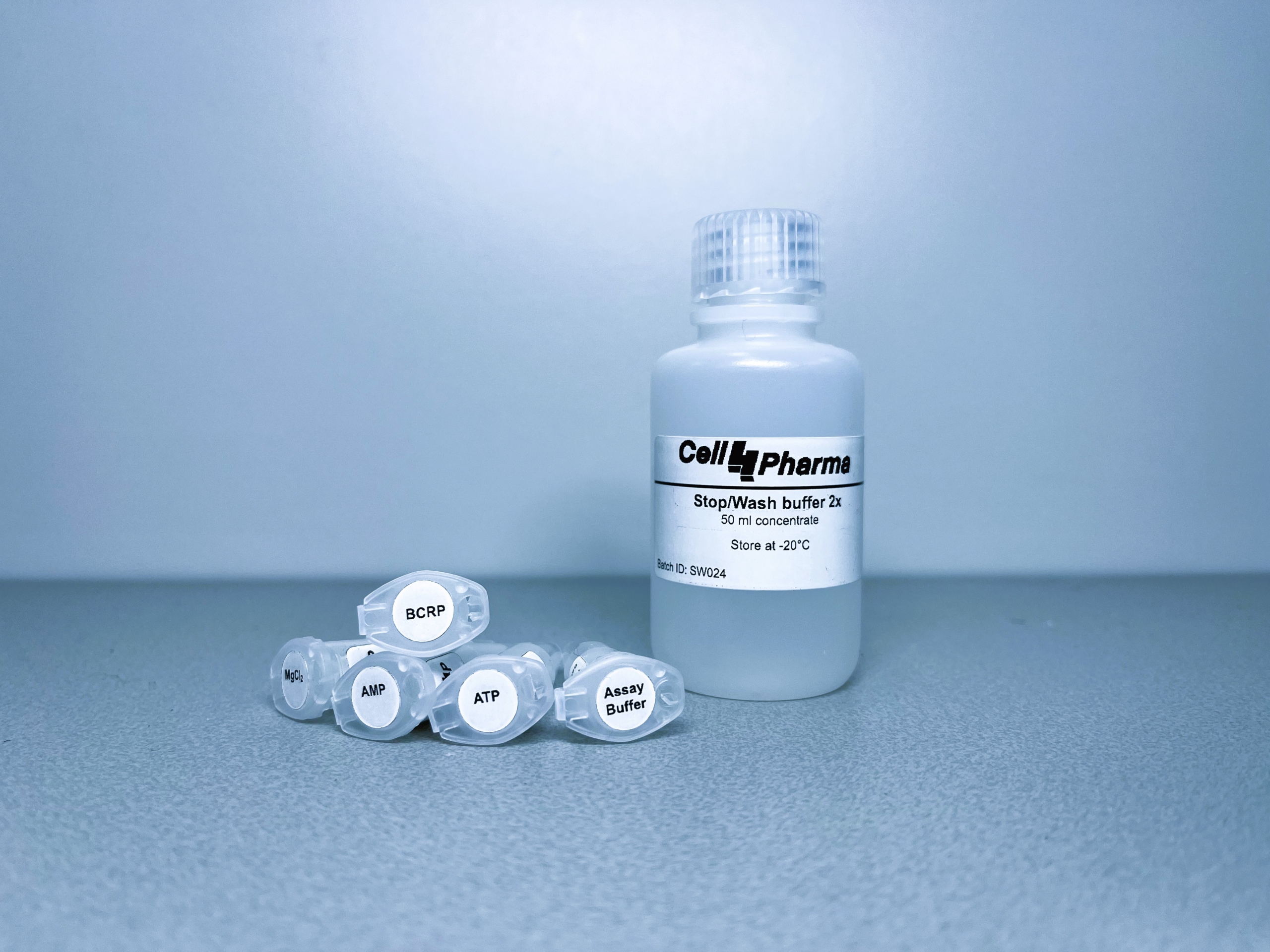
| AMP-ATP solution | 100 mM — Cell4Pharma |
| Assay buffer | Cell4Pharma optimised formulation |
Anwendungen
| Anwendung | Description |
|---|---|
| BSEP inhibition / DILI risk assessment | IC₅₀ determination for BSEP inhibition using taurocholate as probe substrate — primary in vitro screen for drug-induced cholestatic hepatotoxicity risk; supports DILI risk classification alongside clinical transaminase data |
| DDI characterization (FDA/EMA) | Vesicular transport assays to assess whether a new molecular entity (NME) inhibits BSEP-mediated bile salt efflux — supports IND, NDA, and MAA submissions per FDA (2017) and EMA (2013) transporter DDI guidance |
| Substrate identification | ATP-dependent uptake assays to confirm active BSEP-mediated transport of candidate compounds — identifies hepatically cleared drugs that depend on BSEP for canalicular secretion |
| Comparative species studies | Cross-species BSEP inhibition profiling using human, cat, and dog BSEP vesicles — supports preclinical DILI species translation and veterinary drug safety assessment |
| High-throughput screening | 96-well compatible format for screening compound libraries for BSEP inhibition — compatible with radiolabelled taurocholate (³H-TCA), fluorescent substrates, and LC-MS/MS quantification |
Einhaltung gesetzlicher Vorschriften
BSEP (ABCB11) inhibition is a mechanistically established cause of drug-induced cholestatic liver injury (DILI). The FDA Drug Interaction Guidance (2017) und die EMA Guideline on the Investigation of Drug Interactions (2013) recommend in vitro BSEP inhibition assessment for new molecular entities (NMEs) with significant hepatic exposure, particularly those associated with cholestatic signal in clinical or preclinical studies. Unlike other DDI transporters where both substrate and inhibitor status are assessed, BSEP evaluation focuses primarily on inhibition — because BSEP inhibition by a drug reduces bile acid efflux, leading to intracellular bile acid accumulation and hepatocyte injury. The guaranteed ATP/AMP ratio >10 confirms active transport function and supports data quality requirements for DILI risk characterization packages submitted to regulatory agencies.
Available Formats
| Format | Reactions | Art |
|---|---|---|
| Bausatz | 100 Reaktionen | Human BSEP |
| Bausatz | 100 Reaktionen | Cat BSEP — on request |
| Bausatz | 100 Reaktionen | Dog BSEP — on request |
Key Benefits
Guaranteed Activity
ATP/AMP ratio >10 guaranteed per lot — confirms active BSEP-mediated taurocholate transport and assay suitability for DILI risk characterization and regulatory submissions.
Vollständige Dokumentation
Lot-specific CoA with ATP/AMP ratio — from Cell4Pharma ISO-certified facilities. Additional regulatory documents on request.
DACH Expert Support
Exclusive DACH distributor via SeamlessBio — scientific support for assay setup, DILI risk assessment workflows, and regulatory submission queries. 48h response.
Ähnliche Produkte
| Produkt | Verwendung |
|---|---|
| Human Control Vesicle Kit (C4PVK009) | Recommended negative control for BSEP vesicular transport assays |
| Human MRP2 Vesicle Kit (C4PVK-MRP2) | MRP2/ABCC2 hepatic efflux — parallel canalicular transporter assessment alongside BSEP |
| Human P-gp Vesicle Kit (C4PVK010) | P-gp/ABCB1 efflux — complete ABC transporter DDI panel |
| Human BCRP Vesicle Kit (C4PVK-BCRP) | BCRP/ABCG2 efflux — intestinal and hepatic efflux transporter panel |
Häufig gestellte Fragen
Why is BSEP inhibition assessed differently from other DDI transporters such as P-gp or BCRP?
Unlike P-gp and BCRP — where both substrate and inhibitor status of the investigational drug are evaluated — BSEP assessment in the regulatory context focuses primarily on inhibition. This is because BSEP’s physiological role is highly specific: it is the dominant canalicular efflux transporter for conjugated bile salts in hepatocytes, and its inhibition by a drug causes intracellular bile acid accumulation, leading to cholestatic liver injury (DILI). A drug is rarely a BSEP substrate itself; the clinical concern is whether it inhibits BSEP-mediated bile acid efflux in patients. FDA (2017) and EMA (2013) guidance therefore recommend BSEP inhibition IC₅₀ determination using the vesicular transport assay with taurocholate as the probe substrate as the primary in vitro DILI risk screen.
Which probe substrate is used for BSEP vesicular transport inhibition assays?
Taurocholate (TCA, taurocholic acid) is the standard probe substrate for BSEP vesicular transport assays, used in radiolabelled form (³H-taurocholate) in the majority of regulatory DDI studies. Taurocholate is a primary conjugated bile acid, a physiological BSEP substrate, and is cited in both FDA and EMA guidance as the reference probe. Taurolitocholate-3-sulfate (TLCS) is used as an alternative probe substrate when taurocholate transport signal is insufficient. For fluorescence-based detection, fluorescent bile acid analogues compatible with the Cell4Pharma assay format are available. The kit is compatible with all standard probe substrates and detection methods.
What IC₅₀ threshold is considered clinically relevant for BSEP inhibition?
Regulatory agencies do not specify a single fixed IC₅₀ cut-off for BSEP inhibition; rather, BSEP inhibition data are interpreted in the context of total hepatic drug concentration versus the measured IC₅₀. A commonly applied risk classification framework (Dawson et al., Toxicol Sci 2012) defines IC₅₀ values below 25 µM as potentially relevant for drugs with hepatic exposure, particularly when combined with clinical cholestatic signals or elevated ALP/bilirubin in preclinical studies. The key regulatory output is the IC₅₀ value and the relationship between systemic and hepatic drug exposure — not a binary pass/fail threshold. The Cell4Pharma BSEP kit enables precise IC₅₀ determination across a full concentration range, which is the data format expected in DILI risk characterization packages for NDA/MAA submissions.
Are cat and dog BSEP vesicle kits available, and when are they needed?
Yes — Cell4Pharma offers cat and dog BSEP vesicle kits alongside the human kit, available via SeamlessBio on request. Comparative BSEP inhibition studies across species are used in two scenarios: first, in veterinary drug safety assessment where the target species is a companion animal and human BSEP data alone are insufficient; and second, in preclinical DILI species translation, where discordance between rat and dog cholestatic signals is investigated through direct species comparison of BSEP inhibition potency. BSEP amino acid sequence and substrate specificity differ across species, so human IC₅₀ values do not always predict dog or cat BSEP sensitivity — making species-specific kits the appropriate tool when cross-species DILI characterization is required.
Can the BSEP vesicle kit be used as part of a broader ABC transporter DDI panel?
Yes — BSEP is routinely assessed as part of a complete hepatic transporter DDI panel alongside P-gp (ABCB1), BCRP (ABCG2), and MRP2 (ABCC2). While P-gp, BCRP, and MRP2 are assessed for both substrate and inhibitor potential of the investigational drug, BSEP is assessed for inhibition only. Cell4Pharma’s ABC transporter vesicle kit range — P-gp, BCRP, BSEP, MRP1, MRP2, MRP5 — shares a common assay format and buffer system, enabling parallel processing within the same experiment and reducing total assay development time. The Human Control Vesicle Kit (C4PVK009) serves as the single matched negative control across all transporter assays in the panel. All kits are available via SeamlessBio for the DACH region.
Request a Quote or Technical Information
48h response · DACH exclusive via SeamlessBio · Full lot documentation · Cell4Pharma quality
 English
  Deutsch